

FAST-2 tested a brief coached strength routine in older adults. Read the chair-rise and balance findings alongside the orthopedic safety concerns.





In March 2026, the FAST-2 randomized trial was reported in PLOS ONE. It found that a brief daily strength routine with coaching improved chair-rise and one-leg-balance test performance in inactive older adults with walking difficulty. An October 22, 2026 review of the trial revisited those findings and the program behind them.
The timing matters: the October coverage concerned a study published earlier in the year. This was evidence from a specific exercise trial, not a newly issued rehabilitation guideline. Its contribution was a measured improvement after a short home program delivered with support.
For readers rebuilding physical capacity, the important story includes both the results and the conditions under which participants achieved them.
The question leading into FAST-2 was focused: could a short daily functional-strength routine improve measured performance in inactive older adults who already had trouble walking? That is more specific than asking whether exercise in general is helpful.
The researchers compared an exercise group with a control group. They assessed performance on defined tasks rather than relying only on participants' impressions of progress. This comparison provides the context for understanding the reported gains.
According to ScienceDaily's account of FAST-2, the intervention combined home exercise with remote coaching and changes matched to participants' abilities. A brief session and a supported session were parts of the same program.
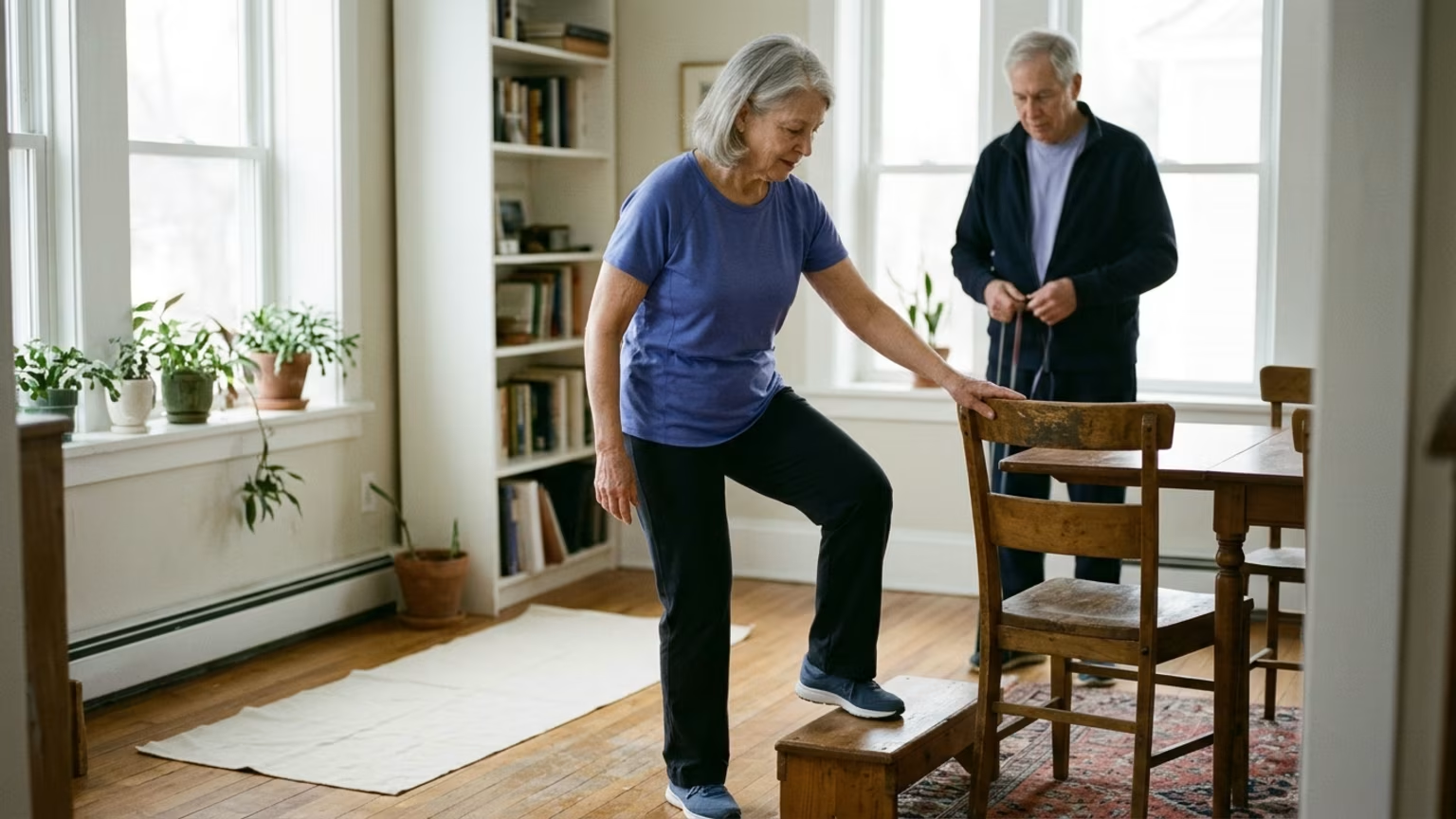
Here, functional strength work included movements such as standing from a chair and stepping up. For broader context on that language, ReboundBody explains how strength relates to everyday movement tasks. The study's contribution was to test a particular approach rather than simply describe those movements.
ScienceDaily reports that the home-based intervention lasted 12 weeks. Participants in the exercise group were assigned four movements:
Each movement was assigned 30 seconds, with 30 seconds of rest between exercises. Participants received remote coaching and exercise modifications based on their abilities. The program also included form feedback and safety instructions.
Compared with the control group, the exercise group improved on three performance tests:
The chair tests capture related tasks in different ways. One counts how many chair rises a person completes within a set time. The other measures how long it takes to complete a set number of rises. The balance test measures performance while standing on one leg.
That makes the findings more specific than the broad phrase “better mobility.” The researchers observed better results on defined tasks after the coached program. The numbers describe improvements relative to the control group, rather than simply changes from the exercise group's starting point.
This distinction is useful when reading exercise headlines. A clearly named test gives readers a better understanding of what the researchers actually measured. It also keeps the evidence tied to an observable result instead of a vague claim about overall recovery.
ScienceDaily reports that FAST-2 randomized 97 adults aged 65 and older. The group's average age was about 74. Participants were inactive and reported difficulty walking a quarter-mile without special equipment.
Those details define the population behind the findings. The study was not simply about anyone described as an older adult. It involved people with both inactivity and an existing walking limitation.
For ReboundBody readers, age may overlap with the trial while the recovery situation differs. Someone returning after surgery or an orthopedic injury is not automatically represented by a study of adults selected for inactivity and walking difficulty. The same applies to someone managing recurring pain after a prolonged setback.
The trial therefore does not establish that its exercise choices are appropriate for an individual recovering from those problems. A clinician or rehabilitation professional can help adapt activity to current limitations.
It also helps to name the goal under discussion. Getting through daily tasks and returning to demanding recreation are different targets. ReboundBody's explanation of the stages between everyday movement and full sport offers language for discussing that distinction with a care team.
The practical value is a more focused discussion about brief exercise and the support around it. The FAST-2 findings give readers a concrete program to ask about, rather than a reason to copy a short exercise list without context.
A useful conversation can begin with the task someone wants to improve. In this study, the clearest changes involved chair-rise and balance tests. Naming the desired task helps keep a discussion connected to the evidence being considered.
Questions prompted by the trial include:
These are discussion points for qualified care, not instructions for starting the study routine. They keep attention on the purpose of the activity and how it would be supported.
For readers preparing for an appointment, it may also help to distinguish a test result from a description of daily experience. ReboundBody's guide to describing changes in day-to-day physical symptoms provides related context for that conversation.
The useful message is not that longer sessions should be replaced with shorter ones. It is that this particular brief program produced measurable gains under the conditions studied. Personal exercise decisions still require attention to the person's recovery situation.
The safety findings deserve the same attention as the performance gains. The detailed review of FAST-2 reports seven orthopedic problems among six participants. The problems were judged possibly, probably, or definitely related to the exercises.
Six events led to missed workouts, and three participants sought professional care. One participant was kept overnight for observation after shoulder pain raised concern about a heart attack. Shoulder discomfort was the most frequently reported location.
The review also identifies a difference between the abstract and the fuller account. The abstract stated that no significant adverse events occurred. That description needs to be read alongside the exercise-related problems that interrupted workouts or led participants to seek care.
In other words, “no significant adverse events” should not be read as meaning that nobody experienced a problem. The practical consequences belong in the account of the trial alongside its positive results.
Several questions also remain unanswered:
The support provided during the trial is another important boundary. Coaching, form feedback and ability-based changes accompanied the movements. Readers should not assume that copying only the exercise list would produce the same results or safety profile.
These uncertainties leave room for further research without erasing the measured gains. They also explain why the program's delivery matters as much as its short duration.
Keep the questions specific and the expectations realistic. Personal recovery decisions belong in a conversation with qualified care.
A four-minute exercise headline can hide the coaching and orthopedic problems behind the results. ReboundBody explains recovery research with clear evidence and realistic limits. Its independent articles serve active adults in midlife and later life who want to understand strength rebuilding and return to activity without medical promises.

Follow ReboundBody for practical articles on injury recovery, rehabilitation, mobility and rebuilding strength. New posts turn research into clear ideas for the road back to activity after injury or surgery.





Read practical guidance on injury recovery, rehabilitation, mobility and rebuilding strength as you work your way back to activity.
Explore Resources