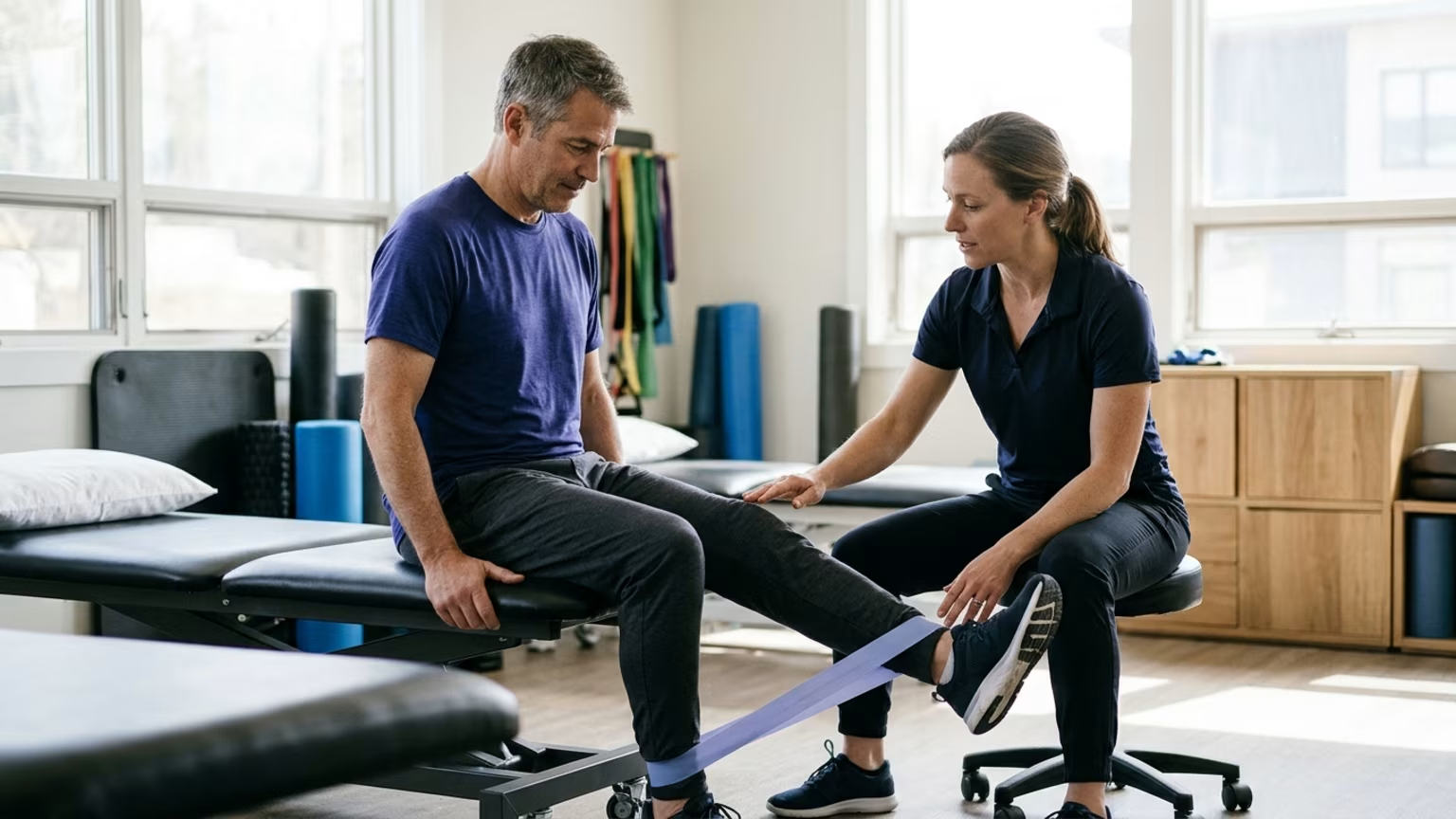

A new knee-exercise guide emphasizes gradual progression. See how it compares with AAOS and NHS advice on symptoms and return to activity.





On November 21, 2026, Sporty Fusion published a practical knee-exercise guide centered on gradual progression and low-impact conditioning. Its main advice is to change one training variable at a time rather than increasing several demands together.
The guide describes strength movements alongside cardiovascular options such as cycling and swimming. For adults returning to activity after a knee problem, the timely point is not a newly proven exercise. It is a way of organizing familiar training choices.
That distinction matters when an online routine looks ready to follow. A list of movements answers a different question from whether those movements fit a particular recovery. The clearest reading places this new overview beside guidance from the American Academy of Orthopaedic Surgeons (AAOS) and the Princess Alexandra Hospital NHS resource.
The AAOS OrthoInfo knee-conditioning program presents exercise as part of rebuilding function after injury or surgery. Its rehabilitation handout says conditioning can support a return to daily activities, recreation and sport. It also places that work under a doctor's supervision so the program fits the person's goals.
Within that specific program, AAOS recommends a 5-to-10-minute low-impact warm-up such as walking or stationary cycling. It describes a program generally continued for 4 to 6 weeks unless a doctor or physical therapist advises otherwise. That is the duration of the resource's program, not a prediction of how long every knee injury takes to recover.
AAOS also says its exercises may continue two to three days per week after recovery to maintain strength and range of motion. This separates a rehabilitation phase from continued conditioning afterward. Completing a program and maintaining physical capacity are different parts of the recovery picture.
The Princess Alexandra Hospital NHS resource adds an important starting point: activity increases should be gradual. It advises beginning exercises gently when comfortable and recognizes that a clinician may give different advice. The newer guide therefore sits within an existing emphasis on measured activity rather than replacing it.
The guide brings exercise selection and progression into the same discussion. Its strength examples are sit-to-stands, wall sits, glute bridges and step-ups. Its low-impact cardiovascular examples are cycling, swimming and elliptical training.
The useful organizational idea is that choosing a movement and deciding how much of it to do are separate decisions. The guide names several variables that can change a session:
It advises changing one of these at a time. As a practical tracking idea, this may make a knee's response easier to interpret than a routine in which several demands change together. That is the report's approach to organizing progression.
This fits the broader idea of rebuilding activity in measured stages. The relevant point is that progression involves more than selecting a harder exercise or adding weight.
The guide also proposes two or three weekly strength sessions and at least two low-impact cardio sessions as a practical framework. That schedule places strength work and cardiovascular activity within the same week. It presents them as parts of the same overview rather than separate recovery topics.
Keeping the sources distinct helps readers see which details come from the new guide and which come from established conditioning resources. That distinction also matters when comparing lower-impact forms of exercise.
The report is not a clinical guideline or research study. It contains no original patient data or trial results, so there is no studied population whose outcomes can be described. Its audience is people seeking practical knee-strengthening information rather than participants selected for a clinical trial.
The proposed schedule has not been validated for every recovering knee. The supporting guidance also does not establish identical exercise tolerance or progression for every diagnosis, surgery or recovery stage. A familiar exercise name does not establish that it belongs in every rehabilitation plan.
For readers in midlife or later life, the most useful role of the exercise list is as material for discussion with a doctor or physical therapist. AAOS's emphasis on supervision gives that discussion a clear purpose: matching conditioning to the person's circumstances and goals. The NHS qualification about comfort and contrary clinician advice serves a similar purpose.
Practical relevance starts with separating an exercise idea from a decision about symptoms. The NHS resource advises avoiding activities that significantly increase pain or swelling. It also advises reducing repetitions or stopping and seeking advice if symptoms increase significantly.
AAOS uses a stricter pain message for its own program: users should not feel pain during its exercises. It recommends consulting a doctor or physical therapist if pain occurs. These statements should remain attached to the programs and resources that made them.
For a reader comparing conflicting online claims, the point is not to combine them into a homemade pain rule. A personal decision about acceptable symptoms belongs in a conversation with the treating professional. The source material provides context for that conversation rather than a replacement for it.
Some symptoms also call for assessment rather than another exercise adjustment. The Princess Alexandra Hospital NHS resource advises urgent medical input for signs including:
The guide also flags inability to fully bend or straighten the knee and pain that persists or worsens despite modified exercise as reasons to seek assessment. These descriptions identify concerns that need evaluation; they do not establish what is causing them.
A useful care discussion can therefore stay focused on a few concrete questions:
These are questions about applying guidance, not a request for everyone to adopt the same routine. They also connect knee-specific exercise to the wider task of rebuilding fitness during orthopedic recovery. The strength list is one part of that discussion rather than the whole recovery plan.
The guide's suggested discomfort score and fixed weekly percentage increases are its own advice. The supporting sources do not independently establish those thresholds as medical standards for knee rehabilitation. Those numerical suggestions should not borrow authority from the broader agreement about gradual activity.
The overview also does not establish whether one of its listed exercises produces better recovery outcomes than another. Naming several options is different from testing them against each other. The practical value lies in organizing possibilities rather than ranking treatments.
The distinction between a broad principle and a precise rule matters here. Gradual activity appears across the guide and the established resources. Agreement on that principle does not settle the size or timing of each increase for a particular recovery.
An exercise list is easy to share. Understanding where it belongs in someone's recovery takes more context. Progress is not simply a harder movement on a page, but a change that makes sense within the larger recovery picture.
Fixed weekly increases can make knee-strength advice look more settled than the evidence supports. ReboundBody's recovery coverage puts contradictory exercise claims in context for people sidelined by injury or surgery, so they can better understand rehabilitation choices and discuss their situation with a qualified clinician.

Follow ReboundBody for practical articles on injury recovery, rehabilitation, mobility and rebuilding strength. New posts turn research into clear ideas for the road back to activity after injury or surgery.






Read practical guidance on injury recovery, rehabilitation, mobility and rebuilding strength as you work your way back to activity.
Explore Resources