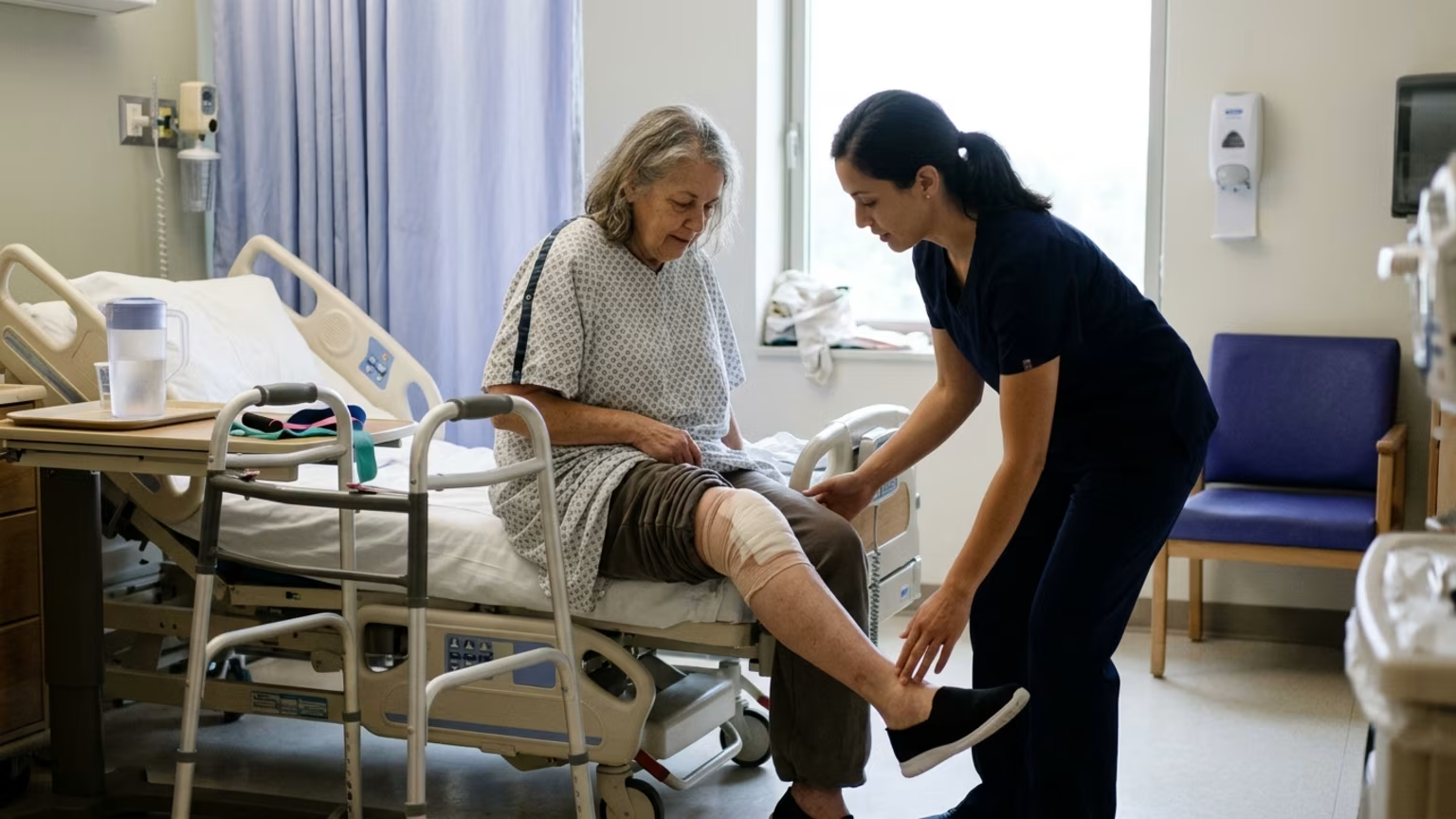

A knee-replacement trial found early motion and strength advantages with modified ERAS. See how the findings changed over time and what remains uncertain.





On October 22, 2026, BMC Musculoskeletal Disorders published a randomized trial reporting better early knee motion and several strength measures with a modified Enhanced Recovery After Surgery (ERAS) pathway. The study compared this coordinated approach with conventional care around primary total knee replacement.
The clearest findings came on postoperative day 5. The trial adds evidence about the first days of recovery rather than introducing a new exercise for patients to try. Its later assessments also help separate an early advantage from lasting differences between care pathways.
ERAS refers to a coordinated approach to care around surgery. A separate instructional review published in the Journal of Orthopaedic Surgery and Research on October 15, 2026 described pain control using several methods, early mobilization and coordinated rehabilitation as common ERAS elements for hip and knee replacement.
That context matters because the new trial did not compare rehabilitation with no rehabilitation. It compared different ways of organizing surgery and the early recovery period.
In the conventional-care group, patients began mobilization on postoperative day 1. They received physiotherapy once daily. Surgery involved a tourniquet and a drain that was removed on day 2.
Both groups were allowed immediate full weight-bearing. They also received standardized antibiotics around surgery and managed their own rehabilitation after discharge.
The comparison therefore concerned the timing and combination of several care elements. It was not simply a test of whether people should move after surgery. The conventional pathway already included movement and physiotherapy.
This is useful background when reading claims that describe ERAS as one special technique. In this trial, the meaningful comparison was between complete care pathways delivered around the same type of operation.
The BMC Musculoskeletal Disorders trial tested a modified pathway with several linked parts:
These details describe the care delivered in the study. They help explain what the researchers meant by “modified ERAS,” rather than leaving the label to stand for an unspecified recovery program.
On day 5, median active knee range of motion was 67.55 degrees in the modified ERAS group and 42.3 degrees in the conventional-care group. The reported difference was statistically significant with p = 0.031.
Active motion refers to movement the patient produces. The finding therefore concerns an early movement measurement rather than only a description of how the operation was performed.
The pattern changed with follow-up. The trial reported no significant between-group range-of-motion differences at 3 or 6 months.
The researchers also used a dynamometer to measure knee-muscle performance. At day 5, the modified ERAS group had statistically significant advantages in several knee-flexion measures.
These included peak torque at 60°/s and total work at 60°/s and 180°/s. Flexion power also favored modified ERAS at both test speeds.
The results were not uniform across every test. The day-5 peak-torque comparison at 180°/s did not reach statistical significance with p = 0.053.
By 12 months, the study reported no significant between-group strength differences. The authors interpreted the overall pattern as support for faster early recovery rather than lasting superiority of the modified pathway.
The important distinction is timing. The study's positive findings were concentrated in early assessments, while the differences became less clear as recovery continued. A headline focused only on day 5 would miss that broader pattern.
The prospective, single-blinded randomized trial analyzed 58 patients. Of these, 31 received modified ERAS care and 27 received conventional care.
Participants underwent primary total knee replacement for osteoarthritis. Researchers assessed them before surgery and at 5 days and 4 weeks afterward. Later assessments took place at 3 months and 6 months, followed by 12 months.
The study involved a selected patient population. Its eligibility criteria excluded people with very limited walking ability before surgery and those with a history of deep vein thrombosis, among others.
Those boundaries belong alongside the findings. The results concern the patients who qualified for this trial rather than every person preparing for knee surgery. They also concern primary replacement for osteoarthritis rather than a broad mix of knee procedures.
For readers considering where this evidence fits, a broader overview of the course of knee-replacement rehabilitation can provide context. The key is to connect a finding with the operation and recovery stage it actually studied.
The most useful practical message is to ask what a hospital's early-recovery pathway includes. The study described a specific package of care, so the ERAS label alone does not explain whether another program uses the same approach.
Questions for a surgical team might include:
These questions focus on how care is organized. They do not require patients to select a medication approach or decide when they should begin walking.
The day-5 results are group findings, not personal recovery targets. A patient should not use the reported knee angle or walking distance as a pass-or-fail test of their own progress. The study's medication choices and therapy schedule should not be copied without advice from the treating team.
For someone worried about early movement, the useful next discussion is how the planned pathway applies to their situation. ReboundBody's coverage of putting movement advice into context after replacement addresses that broader concern.
The trial also offers a helpful way to organize expectations: ask whether a claim concerns the hospital period or recovery months later. Readers thinking beyond supervised care can find related context on planning for the period after formal physical therapy.
That distinction keeps an encouraging early result connected to the part of recovery it measured.
The authors identified several limits that affect how confidently the findings can be applied.
The trial was small and conducted at one center. Some follow-up visits also had fewer participants contributing data. These features limit confidence in how widely the results apply and how precisely later differences were measured.
Many outcomes and time points were compared without adjustment for multiple testing. The authors describe individual significant comparisons as exploratory and hypothesis-generating. In plain language, they are signals that deserve further study rather than settled answers on their own.
The trial cannot identify the most important pathway component. Mobilization timing and physiotherapy frequency differed between groups. Pain management and surgical practices also differed. The authors suggest combined effects may explain the early findings, but the study cannot assign the advantage to one element.
Muscle testing does not fully describe everyday function. The authors note that dynamometer results do not fully capture walking or stair climbing. They also do not fully capture return to work or sport. Early independence is a relevant recovery question, but it was not established simply by the strength measurements.
Later findings do not prove the pathways were equivalent. A lack of statistically significant differences is not proof that both approaches produce identical outcomes. The study's sample size and statistical limits affect that interpretation.
Safety needs broader evidence. Neither group had recorded clinically relevant adverse events, 30-day readmissions or revision surgeries during the reported study period. That is reassuring within this trial, but it does not establish that the pathway is risk-free across broader patient populations.
The separate instructional review also noted that its proposed framework for individualized load progression needs prospective validation. Its discussion provides context rather than a tested personal exercise plan.
Together, these limits support a focused conclusion: this trial adds evidence about an early recovery pathway while leaving important questions about its components and wider use unanswered.
Today, write down one question for your surgical team: “What does your early-mobility pathway include, and how will it be adapted to my needs?”
Assessing an ERAS claim calls for separating hospital care decisions from online treatment advice, where ReboundBody contributes independent explanations of recovery evidence. For active adults dealing with conflicting claims about exercise and recovery tools, its rehabilitation coverage adds context for more informed conversations with qualified healthcare professionals.

Follow ReboundBody for practical articles on injury recovery, rehabilitation, mobility and rebuilding strength. New posts turn research into clear ideas for the road back to activity after injury or surgery.






Read practical guidance on injury recovery, rehabilitation, mobility and rebuilding strength as you work your way back to activity.
Explore Resources