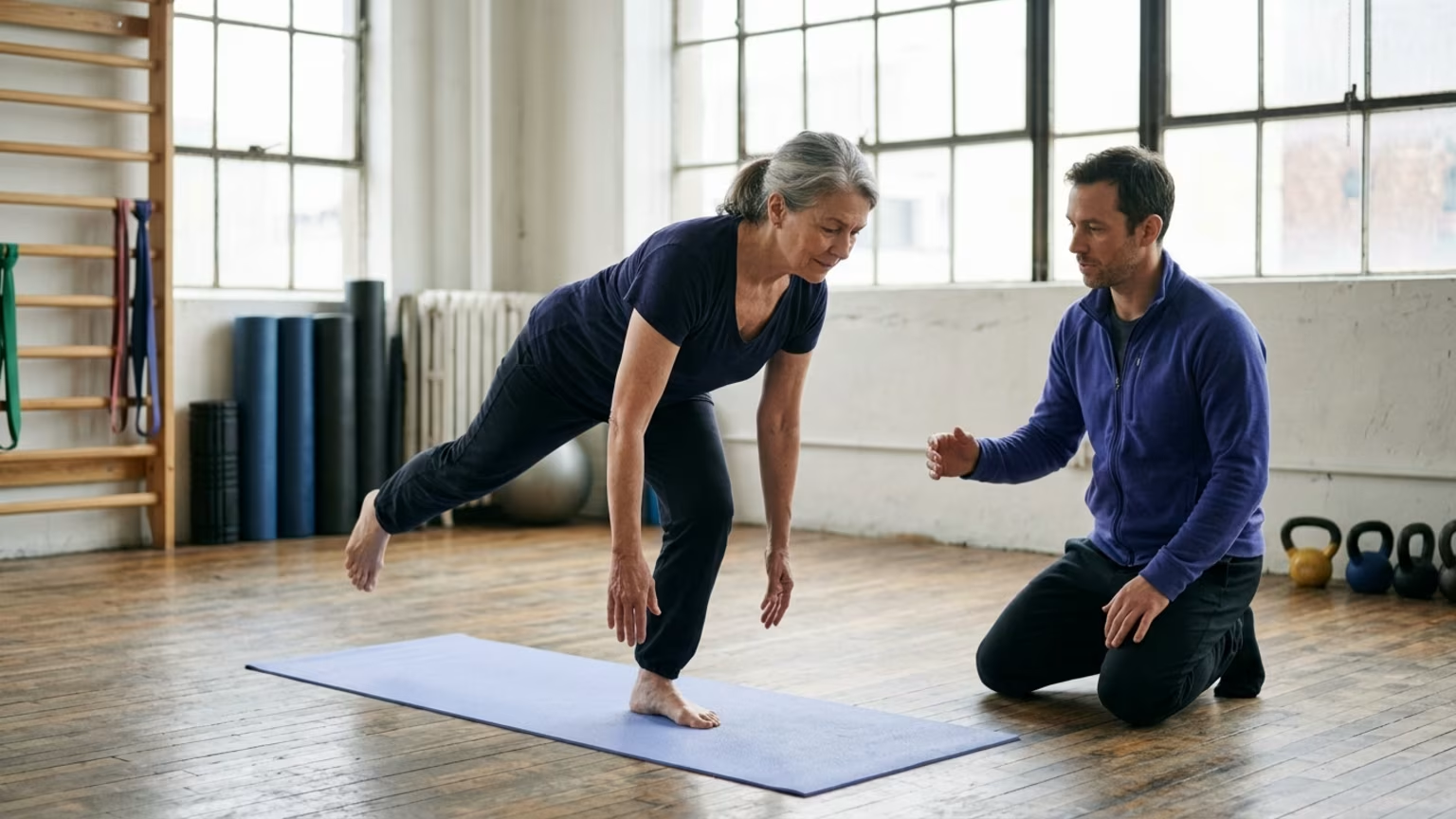

A physical therapy article places movement control alongside strength. Learn how its framework differs from fall-prevention evidence and personal recovery plans.





On October 12, 2026, SPECTRUM Performance and Physical Therapy published a practitioner article on movement quality and longevity. It argues that strength alone does not describe a person’s ability to manage everyday movement demands. Its framework places mobility, stability, coordination and control alongside strength.
This is a fresh explanation of an ongoing recovery topic, not a change in clinical guidance. SPECTRUM’s central idea is that exercise demands can be adjusted through load, range of motion, speed or complexity. Those demands can then progress as a person’s capabilities improve.
For adults returning to activity after a setback, the useful question is broader than how much weight they can move. It also concerns how they manage the movement itself. Understanding that distinction means separating the article’s practical perspective from the narrower research on falls in older adults.
The relevant background includes established fall-prevention guidance. According to Health Affairs’ summary, the USPSTF recommends exercise interventions for community-dwelling adults aged 65 and older who are at increased risk of falls. That recommendation gives exercise a clear role within a defined population.
Health Affairs also summarizes a Cochrane review that found an approximately 24% reduction in the rate of falls with balance and functional exercise programs among community-dwelling older adults. The measured outcome was the rate of falls. It was not a score for movement quality.
This background helps explain why balance and functional movement deserve attention. SPECTRUM’s article did not introduce those ideas into rehabilitation. Instead, it places them within a broader practitioner view of physical readiness and everyday function.
CDC data provide additional public-health context. In 2024, unintentional-fall death rates among adults aged 65 and older were 74.8 per 100,000 for men and 66.6 per 100,000 for women. Rates increased with age and were highest among adults aged 85 and older.
Those figures describe the seriousness of falls at a population level. They do not establish that a particular movement-quality framework changes someone’s risk. Keeping the recommendation, review finding and death-rate data separate preserves what each source actually tells us.
SPECTRUM’s contribution is a way of thinking about exercise and recovery. The article argues that fitness should support life outside the gym. In that view, strength matters alongside the ability to manage changing movement demands.
The framework describes movement quality through mobility, stability, coordination and control. Rather than treating these terms as separate achievements, readers can understand them as different parts of managing a task. The emphasis is on what a person can do with their available strength.
SPECTRUM links this idea to the relationship between demands and current capacity. It presents injuries and setbacks as potentially occurring when demands exceed what someone can currently manage. This offers a way to discuss exercise modification without reducing every decision to whether a task is simply “good” or “bad.”
The article identifies several variables that can change a task’s demands:
Its proposed approach is to adjust those variables and build demands as capability improves. That is a framework for progression, rather than a claim that the heaviest version of an exercise is always the most useful one.
Importantly, SPECTRUM does not frame movement quality as perfect technique. The article notes that anatomy, injury history, capabilities and movement strategies differ between people. It also cautions that compensation is not automatically harmful.
That point changes how the framework should be read. It directs attention toward managing a task rather than matching one ideal-looking movement. A different movement strategy is not automatically evidence of failure.
The sources address overlapping but distinct audiences. SPECTRUM offers a practitioner perspective on strength, movement and progressive challenge. Its discussion is not a finding from a defined study population.
The USPSTF recommendation summarized by Health Affairs has a specific scope: community-dwelling adults aged 65 and older who are at increased fall risk. The Cochrane review summarized in the same publication concerns falls among community-dwelling older adults. These findings should not become claims about all adults or every type of injury.
In particular, the fall-prevention evidence does not establish benefits for general musculoskeletal injury prevention, return to sport or recovery after a specific orthopedic surgery. Those are different questions. Being within the age group also does not by itself establish that someone meets the recommendation’s increased-risk condition.
For a younger adult recovering from an injury, SPECTRUM’s framework may still provide useful language for discussing rehabilitation. That relevance is a practical interpretation of the article, not evidence that the fall-prevention results apply to that person.
SPECTRUM’s practical suggestion is to modify a task and build it back as capacity improves. For readers, the most useful application is understanding the variables that a qualified healthcare professional may consider. It is not choosing a new exercise dose from the article.
This distinction matters after surgery, significant injury or recurring pain. A general framework can help someone follow the reasoning behind a rehabilitation plan. Personal decisions about restrictions and progression remain matters for the healthcare team familiar with that person’s situation.
Load, range, speed and complexity describe different features of a task. In a clinical conversation, separating them can make “progression” more specific. It need not mean only adding resistance.
Questions that follow directly from SPECTRUM’s framework include:
These are discussion prompts rather than screening criteria or exercise instructions. They keep attention on the reasoning behind a plan instead of turning the article into a plan of its own.
For additional terminology, ReboundBody’s explanation of different ways movement occurs during rehabilitation provides related reading. Its resource on rebuilding control for practical tasks addresses another part of this broader topic.
SPECTRUM’s emphasis on life outside the gym suggests another useful discussion point: what is the movement meant to support? That keeps a strength measure connected to a person’s intended activity. It does not make strength less important.
For readers concerned about steadiness after surgery, the role of balance and coordination in recovery is a related subject. The connection is educational, not a reason to substitute a general resource for an existing care plan.
Several limits remain within SPECTRUM’s article. “Movement quality” is not presented as a single quantified clinical measure. The article provides no measurement method and no evidence that its framework is superior to other rehabilitation approaches.
It also provides no numerical training targets, cited studies or formal rehabilitation protocol. There are no medical screening criteria or specific dosage recommendations. Readers therefore cannot use it to determine how much exercise is appropriate or when a particular progression should occur.
The capacity-versus-demand explanation has a related boundary. SPECTRUM does not establish a universal threshold at which load, volume or complexity becomes unsafe. The article also acknowledges that exercise cannot eliminate injury risk.
Clearer evidence would be needed to answer questions such as how movement quality should be measured and which changes matter most for a given recovery goal. It would also need to establish whether this particular framework improves outcomes compared with other approaches. The word “longevity” in the article’s title should not be read as evidence that its approach extends life.
The practical takeaway is narrower: SPECTRUM offers language for considering movement demands alongside strength. The fall-prevention evidence supplies a separate example of why balance and functional exercise matter within a defined older population. Neither requires turning movement into a search for flawless technique.
A strength measure can describe part of physical readiness. The movement someone hopes to return to gives that measure its everyday meaning.
A movement-quality framework loses its limits when it is treated as a personal recovery prescription. ReboundBody explains rehabilitation research in plain language while keeping uncertainty visible. Its independent editorial work supports adults in midlife and later life as they make sense of injury recovery, movement rebuilding and a return to activity.

Follow ReboundBody for practical articles on injury recovery, rehabilitation, mobility and rebuilding strength. New posts turn research into clear ideas for the road back to activity after injury or surgery.






Read practical guidance on injury recovery, rehabilitation, mobility and rebuilding strength as you work your way back to activity.
Explore Resources