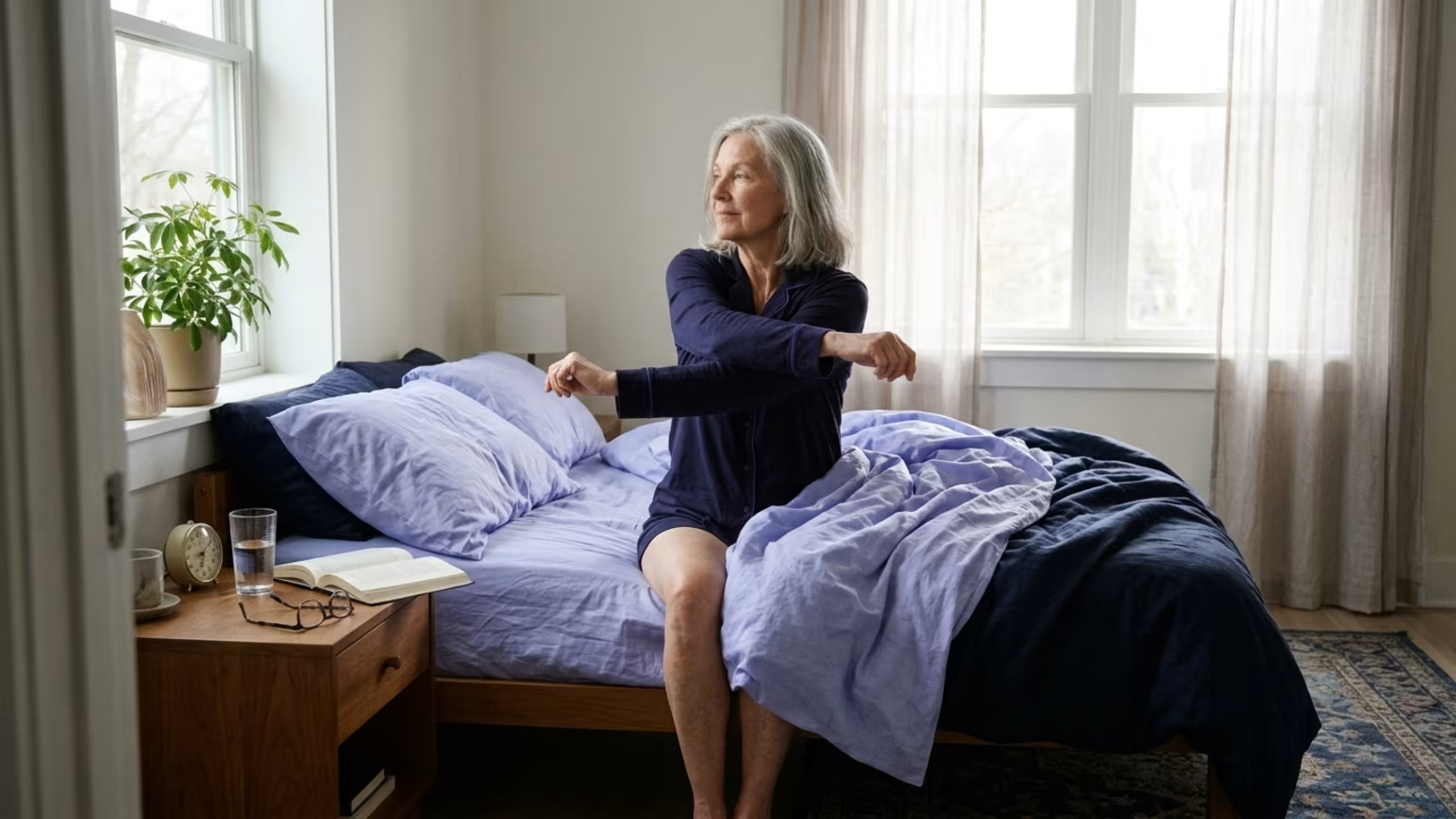

Sleep regularity deserves attention during recovery. Understand the healthy-aging findings, practical discussion points and limits of the evidence.





On October 31, 2026, ABC17 republished a BetterSleep article that encouraged consistent bedtimes and wake times alongside enough opportunity to sleep. Written by Christiana Donohue and reviewed and distributed by Stacker, “The connection between sleep and healthy aging” also called attention to recurring daytime tiredness.
The update puts sleep timing beside sleep duration. The bedside clock is part of the discussion, but so is whether the next day feels restful or tiring. The development is a public-facing summary of sleep advice and research.
For adults rebuilding movement after an injury or surgery, the useful task is to separate that general advice from the findings it summarizes. That makes it easier to bring informed questions to a recovery appointment without treating a health headline as a treatment plan.
The starting point is general sleep-health guidance. The BetterSleep article relays age-based advice about sleep duration and encourages a reasonably consistent schedule. This is advice about making room for sleep rather than reaching one exact number every night.
The article also describes sleep as supporting cell and tissue repair. Its account includes immune function and hormone regulation, as well as appetite and blood-sugar regulation. These are broad health functions that explain why sleep appears in discussions of aging and physical recovery.
For a reader in rehabilitation, the useful background is that sleep belongs within the wider discussion of daily health. The article connects it with everyday function and recovery. Its emphasis includes timing, enough sleep opportunity and attention to recurring fatigue.
That context helps define the practical question: not simply “How long was I in bed?” but also “Was my sleep pattern reasonably steady, and did I feel rested during the day?” Those are different observations. Keeping them distinct makes the article’s message easier to understand.
The article’s main research example concerns sleep regularity. It reports an observational study of 88,975 UK Biobank participants in which more irregular sleep patterns were associated with higher mortality risk during follow-up. The account says the analysis adjusted for several health and lifestyle factors.
Regularity asks about the pattern across nights. Duration asks about the amount of sleep. By discussing both, the article brings attention to more than a nightly total.
The article also reports a review of 22 randomized controlled trials in which regular exercise improved adults’ ratings of sleep quality. Those studies included walking, cycling and yoga.
These findings address different questions. The cohort analysis concerns the relationship between sleep patterns and later health outcomes. The exercise review concerns how adults rated their sleep after an exercise intervention. Neither outcome should be confused with the other when interpreting the article.
The mortality finding concerns UK Biobank participants. The article does not describe that group as people completing orthopedic rehabilitation. For someone recovering from surgery or managing a recurring musculoskeletal problem, this is general health context rather than evidence from a closely matched recovery population.
The exercise review described in the article concerns adults’ own ratings of sleep quality. That outcome is different from a measure of tissue healing or readiness for recreation. Its inclusion does not identify an exercise type or workload suited to a particular injury.
The broader advice on timing and recurring fatigue is relevant to questions adults can raise during recovery. But a broad audience for health advice is not the same as a studied rehabilitation group. Personal decisions still belong with the healthcare professionals who know the person’s condition and care plan.
For readers, the practical relevance is to include sleep in an existing care conversation. The BetterSleep article describes consistent sleep and wake times and enough opportunity for sleep as general-health priorities. These are topics to discuss alongside an individualized rehabilitation plan, not replacements for it.
A brief sleep diary may help show patterns, according to the article. Its value is in making a recurring concern easier to describe. The information can bring together sleep timing and how rested a person feels during the day.
A discussion can distinguish trouble falling asleep from waking during the night. It can also distinguish either problem from daytime sleepiness. This gives the healthcare team a clearer description than the broad statement “My sleep is bad.”
That is a useful frame for thinking about a sleep routine during injury recovery. The focus is on understanding a pattern and communicating concerns rather than grading every night as a success or failure.
The article advises seeking professional input when difficulty falling or staying asleep keeps recurring. It gives the same advice for daytime sleepiness. Persistent tiredness does not have to be treated as an inevitable part of aging or recovery.
According to the article, pain and medications can interfere with sleep. So can illness and stress. These possibilities make sleep a reasonable topic for a recovery visit rather than a concern that must be handled separately.
Questions about medication effects during daily recovery belong with the prescribing clinician. A sleep article is not a basis for changing a medication plan independently.
Loud snoring, gasping or observed pauses in breathing are also worth mentioning to a clinician, the article says. These are observations to report rather than a diagnosis to make from an online description.
Useful conversation starters can stay simple:
These questions bring the article’s general advice into a clinical conversation without assuming the cause of a sleep problem.
The observational finding does not establish that irregular sleep caused the higher mortality risk. The article gives no numerical estimate of that risk and says the study could not determine whether changing sleep patterns would extend life. Neither the cohort analysis nor the exercise review is identified with enough detail to independently check its methods from the article.
The orthopedic question is separate: does a particular sleep schedule improve healing after injury or surgery? The assembled sources provide no direct rehabilitation-trial answer. They do not establish that regularity alone accelerates tissue repair or restores strength.
Postoperative sleep is also the subject of ongoing research. A 2026 BMJ Open protocol describes a planned systematic review and meta-analysis of opioid-sparing multimodal analgesia and early postoperative sleep disturbance in adults. In plain language, it proposes examining how pain-management approaches intended to reduce opioid use relate to sleep soon after surgery.
The protocol says those effects had not yet been systematically synthesized. It is a plan for research rather than a completed set of results. That distinction matters when a publication’s title sounds like an answer to a treatment question.
The BetterSleep article also cautions that longer sleep is not automatically better. Associations between long sleep and poorer health may partly reflect underlying illness or other factors. Adequate sleep opportunity, perceived restfulness and persistent symptoms are therefore more useful discussion points than simply adding more time in bed.
The practical message remains clear despite these unanswered questions. Recurring sleep problems deserve attention within the broader recovery conversation. The evidence supports asking about them without promising a particular healing outcome.
Seen in that light, the bedside clock from the October 31 article has a sensible place. It belongs alongside the recovery plan, not in charge of it.
More consistent bedtimes and wake times give sleep habits an observable focus, and ReboundBody puts that goal in the context of physical recovery. For adults facing conflicting online claims about sleep and treatment options, its independent editorial coverage explains rehabilitation and recovery habits with realistic limits so readers can better understand questions for their healthcare team.

Follow ReboundBody for practical articles on injury recovery, rehabilitation, mobility and rebuilding strength. New posts turn research into clear ideas for the road back to activity after injury or surgery.




Read practical guidance on injury recovery, rehabilitation, mobility and rebuilding strength as you work your way back to activity.
Explore Resources