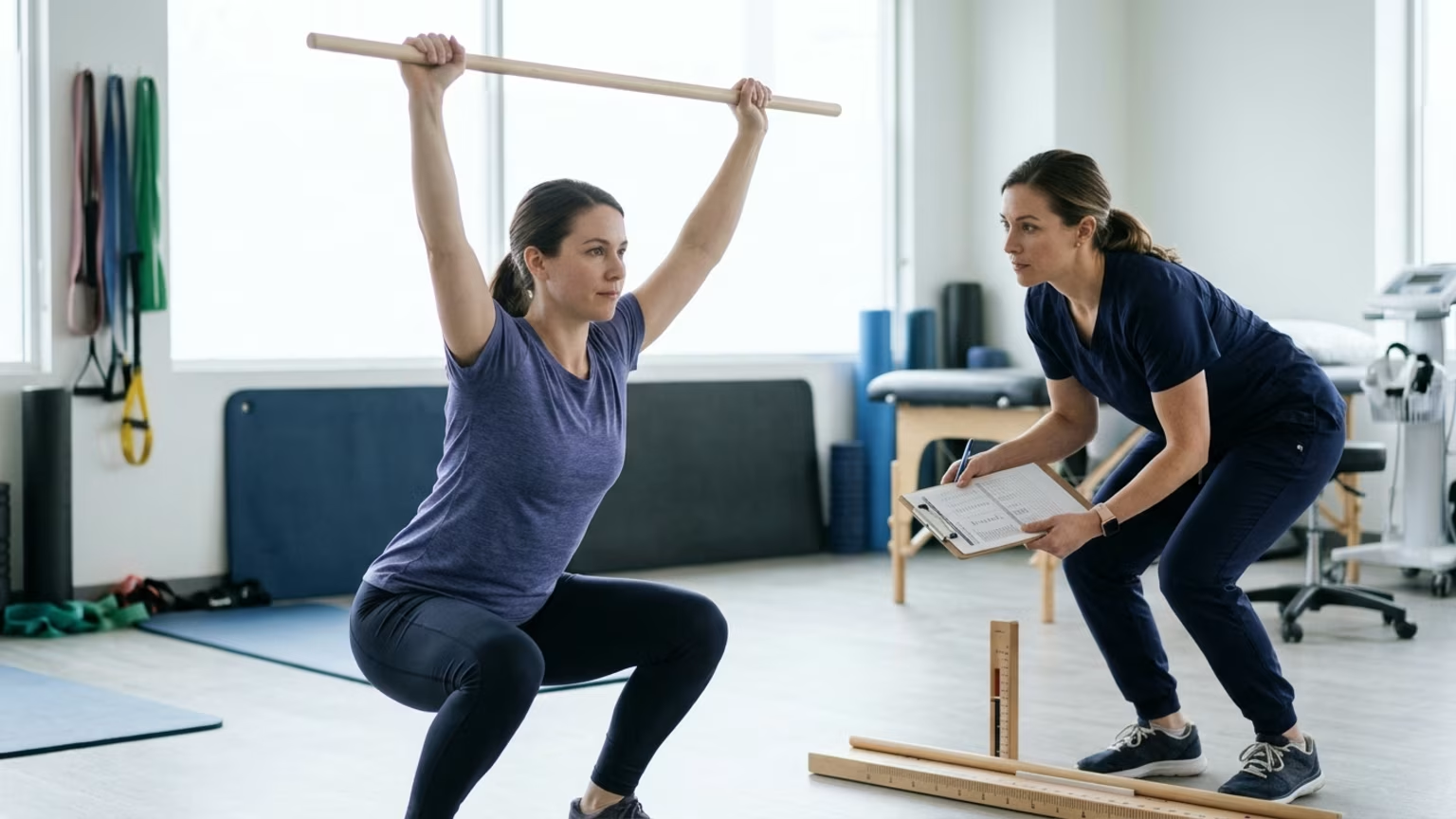

Cleveland Clinic explains the seven-pattern Functional Movement Screen. Learn how scoring works and why results need context during recovery.





In its November 2, 2026 explainer, Cleveland Clinic described the Functional Movement Screen (FMS) as a standardized assessment of seven movement patterns. The article explained how a trained professional can use it to identify movement limitations and differences between sides. This was an educational update about an existing tool rather than a report of a new clinical trial.
According to Cleveland Clinic’s explanation, the screen observes balance, coordination, flexibility and stability. Its practical role is to gather information that may guide further assessment or a discussion about exercise during recovery.
For adults rebuilding movement after an orthopedic setback, the useful question is what those observations add to the recovery conversation. Understanding how the screen works helps put its score in context.
Earlier research examined whether FMS scores were associated with later injury. That is a different question from whether a screen helps a professional notice a movement pattern worth reviewing.
A screening-tools overview discusses a 2019 review that considered whether a score of 14 or lower was associated with increased injury risk. This research context matters because a movement score can be used in different ways. Describing how someone moves today is one use. Trying to forecast what will happen to that person later is another.
Cleveland Clinic’s explainer places the tool in a rehabilitation-oriented role. A trained professional observes the patterns and considers whether a finding deserves more assessment or an exercise discussion. The emphasis is on gathering useful information about the person in front of them.
The article therefore adds a practical explanation of screening rather than announcing a new recovery standard. Its central contribution is showing how individual observations can inform the next question a professional asks.
Cleveland Clinic says the full screen takes about 15 minutes. It includes these seven patterns:
These are the names of the screening patterns, not a home exercise plan. Cleveland Clinic describes the screen as a tool used by a trained professional. The value comes from observing performance against set criteria and interpreting what happens during each pattern.
Each pattern receives a score from 0 to 3. Cleveland Clinic explains the categories this way:
In this setting, compensation means completing the movement with an adjustment in how it is performed. The score records that distinction rather than simply marking the movement as completed or not completed.
The seven-item total can reach 21. But Cleveland Clinic’s Dr. Lewarchick says he pays close attention to individual patterns and side-to-side differences as well as pain. The total is only part of the information gathered.
That emphasis changes how the result is discussed. Instead of stopping at the overall number, a professional can identify which pattern stood out and what happened during it. A finding tied to a particular movement gives the follow-up discussion a clearer focus.
Pain receives a zero in Cleveland Clinic’s scoring description. Dr. Lewarchick calls pain during a test a “red flag.” It is therefore a finding for professional attention rather than a reason to keep repeating the pattern to improve the score.
The distinction matters when reading a score sheet. A result assigned because of pain records something different from a result assigned because the person could not meet the movement criteria. Knowing which occurred is more useful than seeing the number alone.
The injury-prediction review involved healthy, active or athletic participants. In studies that reported mean ages, those averages ranged from 17 to 22.4 years. That range describes study averages rather than the age of every participant.
This is not a close match for many adults in midlife or later life who are recovering from surgery or recurring musculoskeletal problems. The review’s authors specifically called for research involving people outside sport.
That population difference limits how the findings transfer to ReboundBody’s readers. A study of active young participants does not establish how the same score should be interpreted during an older adult’s orthopedic recovery.
The practical response is to keep the research question attached to the people who were studied. When discussing a screening result, it is reasonable to ask whether the supporting evidence concerns a similar recovery setting or a different population.
This does not make the movement observations irrelevant. It separates the information collected during a screen from the research needed to establish what that information means for a particular group. Cleveland Clinic’s emphasis on the individual and their goals provides a useful frame for that discussion.
For someone returning to activity, the most useful output may be a clear explanation of what the professional observed. A total score is easier to understand when it is connected to a named pattern and a reason for follow-up.
Cleveland Clinic says a trained professional can decide whether a finding warrants further assessment or an exercise adjustment. Dr. Lewarchick also emphasizes matching subsequent steps to the individual and the demands they want to meet. That makes the person’s goals part of the interpretation rather than an afterthought.
Questions for a healthcare professional might include:
These questions ask for an explanation rather than a higher score. They also make room for the professional to describe why a particular observation matters in the broader assessment.
For readers unfamiliar with assessment language, understanding how a rehabilitation movement assessment is used offers related background. The aim is to make the discussion easier to follow rather than to interpret every test independently.
A recovery conversation may also include questions about the distinction between tissue healing and functional recovery. Keeping those topics visible helps frame the screen as one part of a wider discussion about returning to movement.
Similarly, readers considering a return to recreation can use ReboundBody’s coverage of how milestones fit into readiness discussions for additional context. The personal decision still belongs with qualified healthcare professionals who can assess the individual situation.
No exercise changes need to follow from reading an explainer. The practical value is being better prepared to understand what a professional recommends and why.
Several questions remain open. The 2019 review’s authors said it was unclear whether a score of 14 or lower was associated with increased injury risk. Differences among participant populations and injury definitions made firm conclusions difficult. The review did not establish a universally reliable cutoff for predicting injury.
There is also a clear boundary around diagnosis. Cleveland Clinic says the FMS does not diagnose the cause of a movement limitation. A low score or a difference between sides does not establish which condition a person has or what caused the finding.
For the same reason, a screening score should not be treated as an individualized injury forecast or as clearance to return to an activity. Those are broader decisions than recording performance across the seven patterns.
What remains useful is the next question. A screen may identify a pattern for a trained professional to investigate. Further assessment can then address what the observation means in the context of that person’s recovery and goals.
This is a measured way to read the Cleveland Clinic update: the screen gathers observations, while the follow-up discussion determines their relevance. Its value is in helping that discussion become more specific.
Today, write down one question for your next healthcare visit: “What would a movement screen add to my current recovery assessment?”
Understanding the follow-up discussion after a movement screen is the next step, and ReboundBody explains the rehabilitation concepts that can arise along the way. For adults in midlife and later life facing unfamiliar clinical terms or research findings, its independent articles provide clear recovery context to support better-informed discussions with qualified healthcare professionals.

Follow ReboundBody for practical articles on injury recovery, rehabilitation, mobility and rebuilding strength. New posts turn research into clear ideas for the road back to activity after injury or surgery.


Read practical guidance on injury recovery, rehabilitation, mobility and rebuilding strength as you work your way back to activity.
Explore Resources