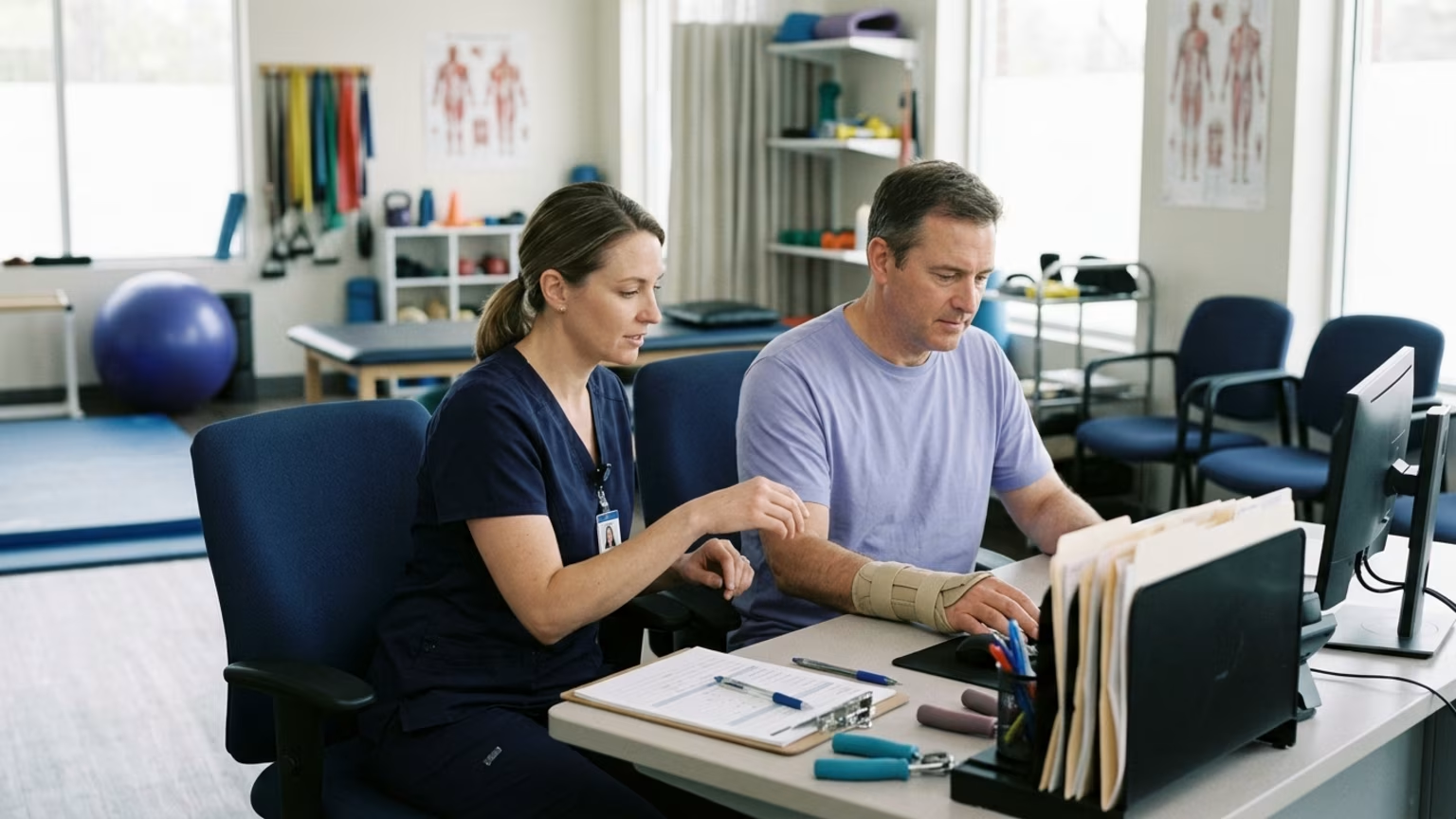

Understand work conditioning, work hardening and the limits of reported return-to-work findings after a prolonged musculoskeletal setback.





A rehabilitation evidence summary published on September 30, 2026 reported encouraging return-to-work findings for work conditioning and work hardening. It described two approaches that connect physical rebuilding with the demands of a person's job. The publication summarized earlier research rather than announcing a new clinical trial.
A related review published on September 23, 2026 in the Journal of Occupational Health examined exercise for office workers with chronic low-back pain. It found possible short-term pain improvement. Its findings also raised an important question about which outcomes rehabilitation research actually measures.
For someone recovering from a prolonged musculoskeletal problem, these publications bring attention to the space between general rehabilitation and employment. The practical issue is not simply whether a program involves exercise. It is whether the program addresses the work a person hopes to resume.
The background described in the September 30 summary is a gap between general physical recovery and job-specific capacity. Improving strength or symptoms addresses part of that picture. The summary's focus is whether rehabilitation also prepares someone for the physical demands of a particular job.
Earlier reviews and trials examined different ways to address that gap. Work conditioning and work hardening are two of the approaches discussed. The summary distinguishes them mainly by their scope.
The summary describes work conditioning as a narrower approach centered on exercise. Its purpose is physical reconditioning tailored to job demands.
The useful distinction is the connection to work. Rather than discussing physical improvement only in general terms, this approach links the rehabilitation goal to the capacity needed for employment.
Work hardening is described as broader and interdisciplinary. It adds job-task simulation and other return-to-work support alongside physical rebuilding.
Job-task simulation means practicing activities that represent work demands. In the summary's framing, this makes the job itself part of the rehabilitation focus rather than only the eventual destination.
These descriptions help explain the earlier evidence context. They also provide a starting point for asking what a particular program includes. A useful way to read the distinction is as a difference in scope, not as a ranking based on the program's name.
The September 30 summary brings together encouraging findings from several studies. The reported outcomes concern returning to employment. They come from different programs and study groups.
The summary reports that a review found a 52% increase in return-to-work rates among people who had been off work for more than four months. It does not clarify whether that figure describes a relative increase or a percentage-point difference. That distinction changes how the number should be understood.
It also describes a separate randomized study involving people who had been off work for at least two months. In that study, work conditioning was associated with a higher percentage returning to work and an earlier return than in the control group.
An interdisciplinary work rehabilitation program reportedly had return-to-work rates of about 84% at discharge, according to the summary.
The summary also describes a rotator-cuff rehabilitation trial. It reports that 71% of participants in a workplace-based group returned to work after four weeks. The reported figure for the clinic-based group was 37%.
These results draw attention to job-focused rehabilitation as a subject worth studying. The workplace-based finding is especially relevant to the question of how rehabilitation connects with actual work demands.
The practical reading is narrower than choosing a program by its most striking percentage. The findings encourage attention to work-related capacity. They do not turn a program label into a personal recovery forecast.
The work-rehabilitation evidence summarized in the September article concerns several distinct groups. Some participants had experienced prolonged absence from work. Another reported trial involved rotator-cuff rehabilitation.
Those details matter because a program's goals are tied to the demands of employment. For a reader considering the relevance of a study, useful questions include whether the injury resembles their own and whether the work demands are similar.
The Journal of Occupational Health review involved a different population: office workers with chronic low-back pain. It included four randomized trials with 263 participants. Its focus was exercise rather than testing work-hardening programs.
That review belongs alongside the work-rehabilitation discussion as context. It helps show why researchers need to distinguish symptom outcomes from work outcomes. It should not be treated as another trial of work conditioning or work hardening.
For adults in midlife or later life, the most relevant connection is the recovery question being studied. Returning to employment is one specific goal. Understanding which people and which tasks a study addresses is more useful than assuming that every musculoskeletal rehabilitation result applies equally.
The evidence supports discussing whether rehabilitation addresses the actual tasks and physical demands of the job. General strength or pain improvement should not be treated as the whole answer to a work-readiness question.
This is a way to make the conversation more specific. Instead of asking only whether recovery is progressing, the discussion can address what that progress means for employment. Decisions about an individual's program belong with qualified healthcare professionals.
Questions that follow directly from the evidence include:
The first question is especially useful because the summary notes that program labels can be used loosely. Understanding the content gives a clearer basis for discussion than relying on the name alone.
Job-focused rehabilitation also connects with the broader topic of gradual activity progression. Here the central issue is what that activity is building toward. The intended work demands give the rehabilitation goal a specific context.
Readers can also find related discussion of readiness beyond symptom relief. In this article, the distinction is between feeling better and understanding whether job-related capacity has been addressed.
A September 15, 2026 overview in American Family Physician offers general rehabilitation context. It notes that some rehabilitation programs allow pain during exercise. When progress is inadequate, it advises clinicians to examine adherence and ongoing mechanical overload. It also recommends considering whether the exercise prescription is appropriate.
That overview is not evidence about work hardening or permission to change an exercise plan independently. Its relevance is the review process: limited progress gives the treating team a reason to examine the program rather than assume that more effort is the answer.
For broader context, understanding recovery through milestones offers another way to frame questions about progress without treating a study timeline as a personal deadline.
The September summary says more carefully controlled research is needed to identify which program format works best for which populations. It does not establish a universally superior choice between work conditioning and work hardening.
Several evidence limits deserve attention:
The office-worker review adds a separate caution about outcome measurement. It rated the evidence for short-term pain effects as very low certainty. It found insufficient evidence for functional and physical-activity outcomes. None of its included trials measured work productivity or presenteeism with validated instruments.
Presenteeism concerns functioning at work while a health problem is present. The measurement gap matters because symptom improvement and work performance are different questions. A study needs to assess the outcome that a claim is about.
Future research needs to clarify which people benefit from which formats. Useful questions also include whether return to employment is sustained and how programs relate to the demands of different jobs. Those are questions for research, not conclusions supplied by the reported percentages.
For now, the clearest practical message is to connect rehabilitation discussions with the actual goal of returning to work. The program's content and the relevance of its evidence deserve more attention than its headline result.
Today, write down one job task you are unsure about and bring it to your next rehabilitation discussion.
Return-to-work percentages can create misplaced confidence when they are treated as proof of readiness for a specific job. ReboundBody puts research in plain language for adults in midlife and later life who are unsure how formal rehabilitation connects with normal activity, helping them prepare informed questions for their healthcare team.

Follow ReboundBody for practical articles on injury recovery, rehabilitation, mobility and rebuilding strength. New posts turn research into clear ideas for the road back to activity after injury or surgery.





Read practical guidance on injury recovery, rehabilitation, mobility and rebuilding strength as you work your way back to activity.
Explore Resources