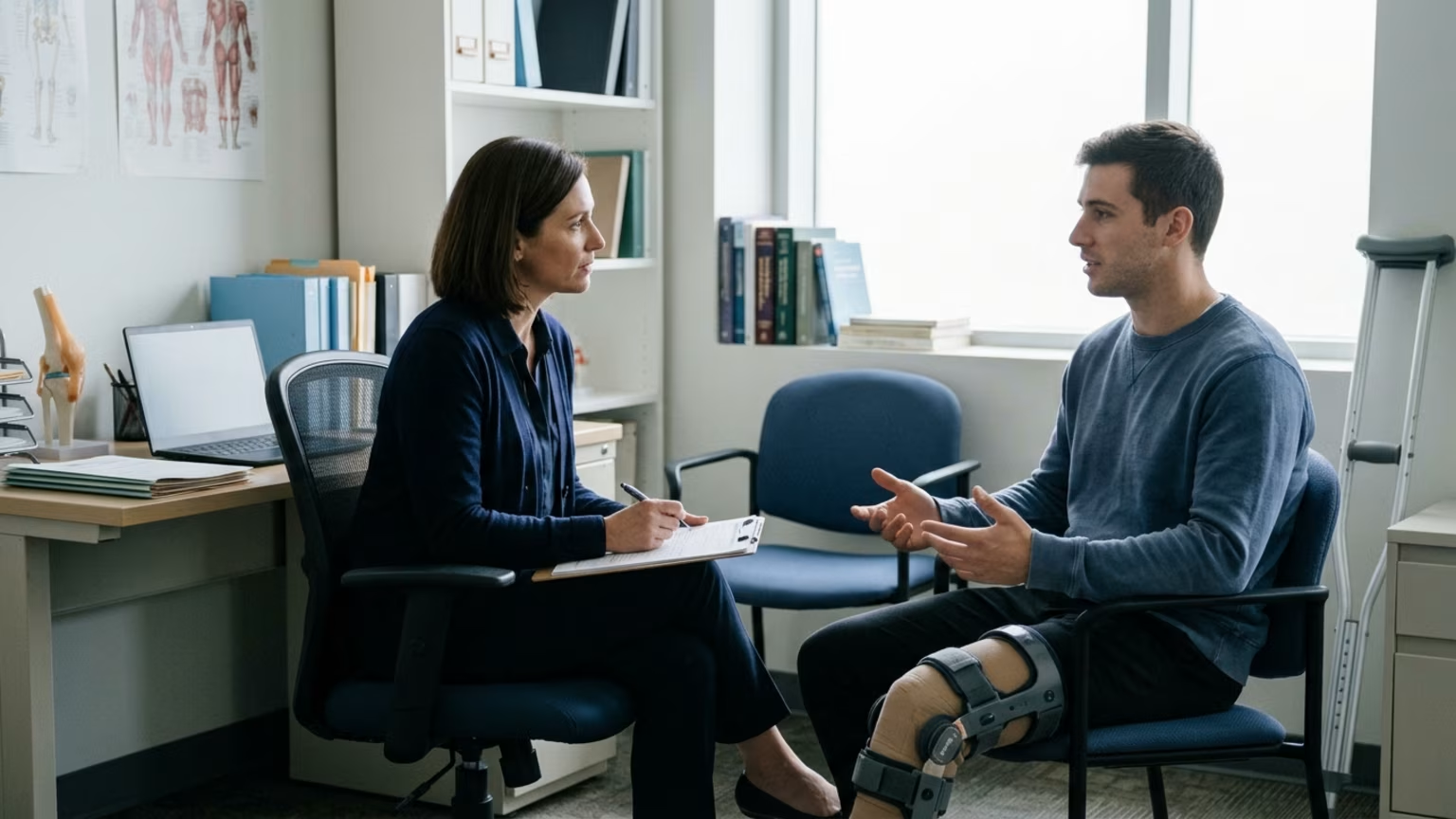

Duke will test a pain-support navigator in orthopedic care. Learn who the study includes, how it fits existing evidence and what remains uncertain.





On October 26, 2026, the Duke Department of Orthopaedic Surgery announced a two-year NIH-funded study of a Psychological Support and Resource Navigator program. The proposed navigator would help orthopedic clinicians identify patients with high pain-related psychological distress and connect them with education and support. Trevor A. Lentz is leading the project.
The study centers on a connection within orthopedic care: helping patients reach resources for coping with pain-related distress. Those resources may include online programs, psychologically informed physical therapy and counseling. The navigator would also explain the relationship between pain and distress and teach brief pain self-management skills.
For people navigating injury or surgery, the announcement raises a practical question: how does psychological support fit alongside physical recovery? Existing research provides some context. Duke’s project adds a focused effort to study how patients can be connected with that support.
The National Institutes of Health describes physical therapy as an option that may help people recover after injury or surgery and manage chronic pain. Its patient information also lists counseling as a possible source of support for people living with pain.
NIH frames pain care partly around function, meaning what a person is able to do. Education and support may play a role for some people with chronic pain. Attention to sleep, mood and stress may also be helpful components of care.
This framing does not mean pain is imaginary or “all in the mind.” Physical and psychological approaches can both have a place in pain care. Duke’s announcement places psychological support alongside orthopedic care rather than treating them as competing explanations for a person’s symptoms.
Before Duke’s announcement, a 2026 systematic review in the Journal of Orthopaedic Surgery and Research examined psychologically informed physical therapy after lower-extremity surgery. It included seven randomized trials with 944 participants. The operations studied included knee and hip replacement, ACL reconstruction and traumatic fracture fixation.
The review found statistically significant pooled results favoring psychologically informed physical therapy for knee function, pain catastrophizing and kinesiophobia. The latter terms concern negative thoughts about pain and fear of movement. However, the review found no between-group differences for pain-intensity measures or several other outcomes.
The authors described the evidence as preliminary. The trials were few and differed from one another, while study quality varied. They called for more standardized treatment approaches and trials large enough to give clearer answers.
Duke’s R21 project is titled “Enhanced Navigation to Improve Pain-related Psychological Support and Resource Use in Orthopedics.” Its proposed contribution is a navigation program that links recognition of distress with education and access to additional resources.
According to Duke, the planned navigator has several connected roles:
These are related tasks, but they are not identical. Explaining pain is an educational role. Teaching a brief skill is a form of self-management support. Helping someone reach another service is the navigation part of the program.
That distinction matters when reading the announcement. A resource navigator is not the same thing as a full course of physical therapy or counseling. Duke describes a way to help patients reach potentially helpful options, not a single treatment that replaces each of those services.
The study will assess feasibility and patient acceptability. In plain language, those questions concern whether the approach can be put into practice and how patients receive it. This makes the project an evaluation of a proposed connection within care rather than simply another study of a particular therapy technique.
Duke says the evaluation will involve 63 patients with high psychological distress who are receiving care in its Department of Orthopaedic Surgery. High distress is a defining feature of the planned group. The project should therefore be understood in that setting rather than as a study of every person with an orthopedic problem.
The related physical therapy review studied a different group: patients after lower-extremity surgery. It also examined therapy interventions rather than Duke’s navigator. Its findings provide context for the kinds of support a navigator might help people reach, but they are not findings about the navigation program itself.
A separate 2026 acute-low-back-pain guideline offers another example of a defined population. According to the University of Washington Rehabilitation Medicine summary, it recommends psychologically informed physical therapy for patients considered at risk of chronic low-back pain. The approach combines physical rehabilitation with strategies addressing thoughts, feelings and behaviors that may affect recovery.
That recommendation concerns acute low-back pain, not Duke’s broader orthopedic population. The guideline also distinguishes patients without signs suggesting a serious underlying cause from those who may need further medical evaluation. ReboundBody’s explanation of how staged low-back-pain care is organized provides related context.
The practical relevance is a conversation about available support. Patients can ask their treating team about options when worry, distress or difficulty coping with pain is getting in the way of recovery. That conversation does not require assuming that Duke’s proposed program is already available outside the study.
Useful questions could include:
These questions leave personal decisions with qualified healthcare professionals. They do not prescribe a particular therapy or assume that everyone needs the same kind of help. The available evidence does not establish that every orthopedic patient needs counseling or psychologically informed physical therapy.
Duke’s proposed navigator should not be treated as a replacement for orthopedic assessment, physical therapy or individualized medical care. Its intended role is to help connect patients with support within the wider care process. Readers sorting out who does what may find context in ReboundBody’s guide to the different roles on an orthopedic recovery team.
It is also useful to keep the purpose of a service clear. Pain education, physical rehabilitation and counseling have different roles in the research described here. A discussion about one does not automatically settle decisions about the others.
For someone already attending rehabilitation, the relevant question is how additional support would fit with existing care. ReboundBody’s overview of what a postoperative physical therapy visit may involve offers background for understanding that discussion. The treating team remains the source for decisions about an individual recovery plan.
Duke’s announcement does not report a comparison group or completed outcomes for pain, function, rehabilitation participation or return to activity. It is therefore not evidence that the navigator has already improved recovery. Feasibility and patient acceptability are the immediate questions being evaluated.
Duke expects the findings to inform a future comparative-effectiveness trial. Such a study would address a different question from whether the navigation approach can be delivered and accepted. The proposed project is an early step toward that later research, not the result of it.
For readers, the larger unanswered question is whether connecting patients with these resources will lead to meaningful differences in recovery. It will also matter which patients benefit from which forms of support. Those are questions for further evidence rather than conclusions to draw from the announcement.
Timing remains open as well. Although Duke describes a two-year project, the announcement does not provide a calendar end date or say when results will be published. The project’s stated duration is not a publication schedule.
The October 26 announcement is best read as a plan to build a connection between orthopedic care and pain-related psychological support. The next meaningful update will be what Duke learns about making that connection work for the patients it is studying.
After learning about a proposed pain-support navigator, the next step is understanding how support fits into the wider recovery journey. ReboundBody explains rehabilitation and recovery habits for active adults facing injury or surgery, with attention to realistic expectations and questions to discuss with healthcare professionals.

Follow ReboundBody for practical articles on injury recovery, rehabilitation, mobility and rebuilding strength. New posts turn research into clear ideas for the road back to activity after injury or surgery.



Read practical guidance on injury recovery, rehabilitation, mobility and rebuilding strength as you work your way back to activity.
Explore Resources