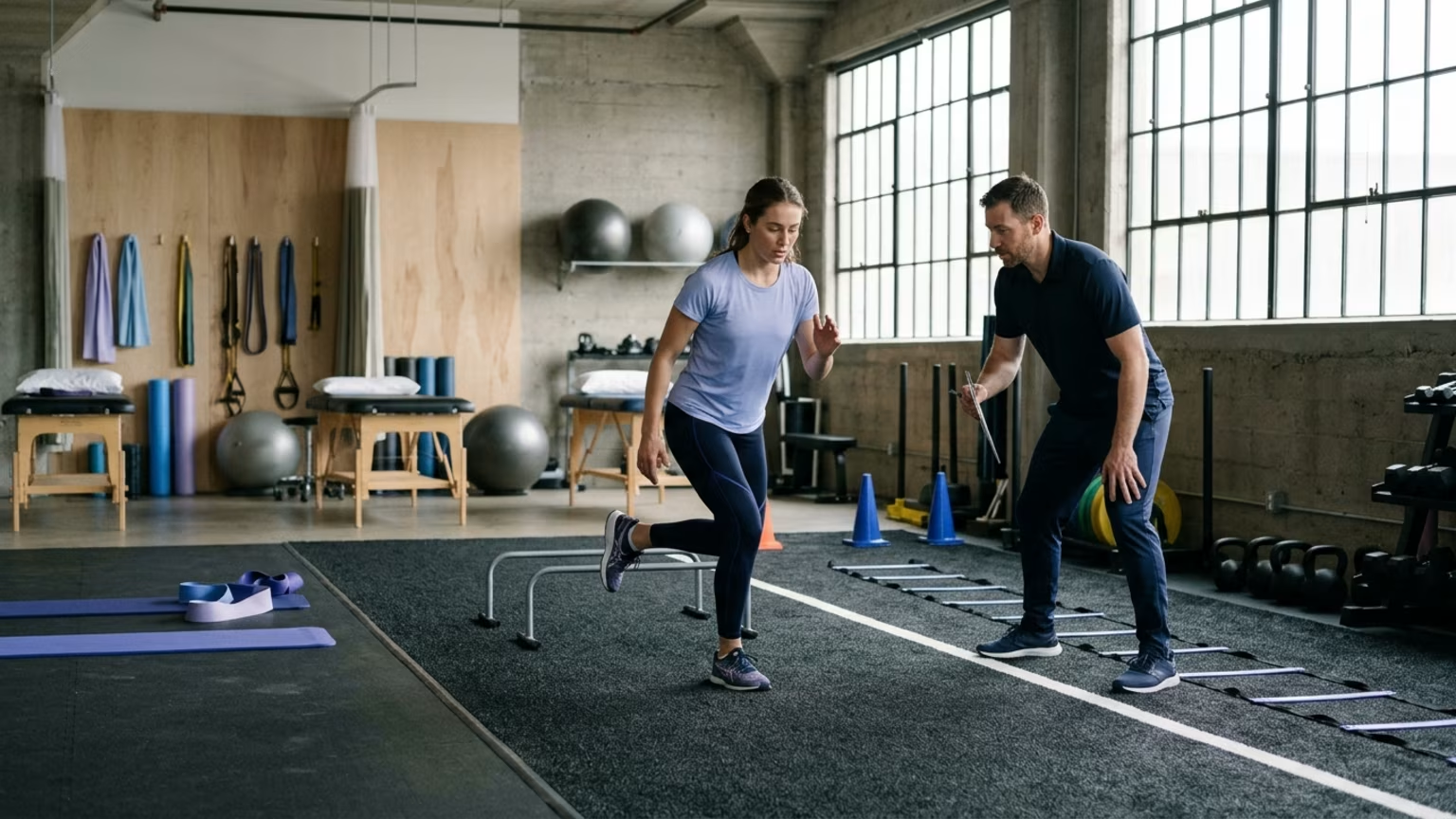

Everyday comfort and strength differ from sport readiness. Learn how research frames sport-specific tasks, training demands and recovery discussions.





A 2026 Sports Medicine review of football after ACL reconstruction says meeting common return-to-sport criteria does not establish competition readiness. That distinction matters because comfort during ordinary movement and readiness for demanding sport answer different questions. A clear return plan needs to explain the space between them.
The belief is understandable: if daily tasks feel normal and pain has settled, returning to a favorite sport may seem like the obvious next step. If someone has also heard that they are “cleared,” that expectation can feel even more reasonable.
Being comfortable again is meaningful. It is not a small achievement after an injury or surgery. The mistaken part is treating success with everyday activity as evidence that every demand of sport has already been addressed.
A useful distinction is between permission for a particular activity and preparation for everything that activity may involve. “Cleared for what?” is a more precise question than “Am I cleared?” The answer might concern ordinary movement, some participation or a return to the full demands of a sport.
The 2026 Sports Medicine review describes a continuum rather than a single finish line. In its football setting, return can extend from rehabilitation and return to play toward sustained performance.
The model separates related milestones:
This is why “I can do normal life again” and “I can manage full training” should not be treated as the same statement. The review describes strength and other physical qualities alongside progressive exposure to sport and training workloads. Strength is part of the picture, not a replacement for that exposure.
A staged view of returning to activity helps put these terms in order. The point is not that an early milestone lacks value. It is that each milestone answers a narrower question than the next.
In the football review, later rehabilitation includes movement quality in realistic sport situations. It also includes technical and tactical retraining. Physical demands include speed, acceleration and deceleration. Changes of direction, endurance and maximal strength are also part of the picture.
The review makes another important distinction: separate physical abilities are not enough on their own. Players also need progressive exposure to training intensity, volume and density. In plain language, that concerns how demanding the work is, how much there is and how closely it is packed together. The review relates that exposure to the workload of team training.
The 2026 review Calf Injuries: An Anatomy-Based Approach to Diagnosis and Rehabilitation offers a condition-specific perspective. It says return decisions should combine clinical recovery, functional capacity and sport demands with consideration of risk. It does not support deciding from elapsed time or a single assessment alone.
The limits belong alongside those findings. The football review concerns players after ACL reconstruction, so its training demands are not a universal program for recreational adults. The calf review reports that a validated test battery and universal calf-specific thresholds have not been established. These reviews also do not establish that a generic staged sequence prevents reinjury for everyone.
Together, they support a way to organize recovery questions rather than a formula for self-clearance. The treating clinician still needs to consider the person's procedure, healing status and symptoms alongside their activity goals.
The practical starting point is a clear description of the activity someone hopes to resume. “Exercise” is a broad goal. Walking for exercise, returning to a class and playing recreational tennis raise different questions about the demands involved.
The football review supports matching later rehabilitation to the intended sport. For a recreational adult, the useful lesson is to describe the actual goal rather than borrow the workload of a football player. A clinician can then relate that goal to the person's recovery.
Useful discussion questions include:
These questions make the conversation more specific without turning a published framework into a personal training plan.
Language can make the transition sound more complete than it is. In the football review, entering a return-to-performance phase is not the same as already meeting the demands of competition. That distinction gives a practical purpose to asking what a term means.
A discussion about “return” can name both the activity and the level of involvement. It can also separate permission to participate from the work still being assessed. Clear wording does not replace assessment, but it helps everyone discuss the same goal.
Ordinary strength remains important within this picture. The football review includes maximal strength among the physical qualities involved in return to performance. Its central message is not that strength work stops mattering once sport becomes the goal.
Instead, foundational capacity and sport exposure serve different purposes. A strength assessment addresses an aspect of physical capacity. Exposure to an activity addresses the demands of doing that activity. Neither should be made to stand for the whole recovery process.
Thinking about how basic strength relates to everyday tasks can make this distinction easier to understand. It keeps the early achievement in view while leaving room for later goals. Comfortable daily movement is progress, even when the next discussion concerns a more demanding activity.
The football review describes restoring sport-specific movement through progressive technical retraining. It names acceleration, deceleration and changes of direction among the relevant demands. These are examples from that sport, not exercises that every reader needs.
For a different activity, the discussion should center on what that activity actually involves. Does it include faster movement or impact? Does it involve changing direction or responding to a changing situation? Those questions help explain why a general statement about strength may leave important details unanswered.
The useful bridge is a connection between the intended activity and the tasks considered during later rehabilitation. “Sport-specific” should have a clear meaning in that conversation. It should describe a relevant demand rather than simply label an exercise as advanced.
A separate question is whether someone is prepared for the amount and pattern of training. The football review explicitly distinguishes individual physical capacities from tolerance of cumulative training loads. Completing a movement is therefore not the whole question the review asks.
Intensity, volume and density help describe that wider demand. They shift attention from a single effort to how demanding a session is and how the work is arranged. This gives readers a more useful meaning for “training readiness” than simply being able to demonstrate a movement.
For discussions with a healthcare team, useful questions include:
The answers belong to the individual recovery plan. The review supplies the reason to ask about workload, not a set amount that every adult should complete.
Recovery discussions also need room for concerns that arise between assessments. The calf review supports considering clinical recovery alongside function and activity demands.
If pain, swelling or loss of function raises concern during rehabilitation, the research supports seeking individualized advice. Organizing observations about changes in the body's response can help prepare that conversation. Those observations are information for the treating team, not a stand-alone readiness score.
Everyday comfort and strength are worthwhile recovery milestones. They are not interchangeable with preparation for a sport's speed, movement demands and repeated workload.
The clearest lesson from the football and calf reviews is to make the next question specific: ready for which activity and which level of participation? A useful bridge connects current capacity with relevant tasks and the demands of training. Decisions about moving along that bridge belong in a conversation with the healthcare team.
Confusing a return-to-sport milestone with full training readiness can make research sound more certain than it is, so ReboundBody explains recovery evidence with clear limits. For active adults in midlife and later life, its independent editorial coverage translates clinical terms and research findings to support better-informed discussions about rehabilitation and return to activity.

Follow ReboundBody for practical articles on injury recovery, rehabilitation, mobility and rebuilding strength. New posts turn research into clear ideas for the road back to activity after injury or surgery.




Read practical guidance on injury recovery, rehabilitation, mobility and rebuilding strength as you work your way back to activity.
Explore Resources