

New everyday balance advice offers practical ideas for aging adults. Learn how it fits WHO guidance and where injury recovery needs individual care.





On October 31, 2026, Martha Stewart Living published “5 Everyday Ways to Help Maintain Your Balance as You Age” on Yahoo Health. The article highlighted supported standing, walking drills and lower-limb movement as ways to practice balance during ordinary routines. It quoted physical therapists Bill McGehee and Christine Annie on making that practice manageable rather than elaborate.
The practical emphasis is on familiar activities: standing with support, moving sideways and paying attention to ankle movement. For adults thinking about mobility with age, the article offers examples of what balance practice might involve. Understanding how those examples connect with broader exercise guidance is especially important for readers rebuilding movement after a physical setback.
The broader principle behind the article was already part of falls-prevention guidance. The World Health Organization recommends tailored exercise that challenges balance and improves functional strength for older adults living in the community. Its guidance also calls for regular progression and enough duration to support the program’s purpose.
“Tailored” is a key word. It means the exercise approach should fit the person rather than ask everyone to follow the same routine. Progression is part of that approach, but so is selecting a suitable starting point.
WHO also identifies tai chi as a useful option. That places the article’s familiar standing and walking activities within a wider range of possible balance-focused exercise approaches. The five suggestions are examples within that broader picture, rather than the whole picture themselves.
For readers rebuilding physical capacity, this context keeps balance connected with strength. WHO’s guidance includes both balance challenges and functional strength rather than treating either as a complete answer alone. ReboundBody’s coverage of adapting strength work around mobility limits provides related background on that distinction.
The Martha Stewart Living article translates the general idea of balance practice into recognizable movement categories. Its contribution is practical presentation: examples that readers can picture and bring into a conversation about exercise.
The article describes single-leg standing with a counter for hand support and a chair behind the person. Its experts connect the idea with ordinary moments such as waiting for coffee or brushing teeth.
Those examples illustrate the article’s short-bout approach. They are about making practice part of a routine rather than building an elaborate workout around it. The support is also part of the suggestion, not a detail to leave out when retelling it.
According to the article’s experts, heel-to-toe walking narrows the base of support. In plain language, the feet move along a narrower path than they would during ordinary walking.
That explains why a familiar action can become a different balance task. The useful point is the type of challenge being described. It is not simply more walking, but walking with a particular demand on control.
The article groups sit-to-stands and side steps among its lower-body suggestions. Its experts describe side steps as a way to challenge lateral control, meaning control during sideways movement.
This broadens the discussion beyond holding still on one leg. The article includes rising from a chair and moving sideways alongside its standing and walking examples. That mix reflects its focus on practical movement demands rather than a single balance pose.
Ankle rocks and circles make up another category. The article’s experts connect ankle mobility with adjusting to uneven ground.
For readers sorting through exercise terms, this is a useful distinction. The ankle examples focus on movement at the joint, while the standing and walking examples create different balance demands. ReboundBody’s guide to ankle movement in walking and standing offers more context on that relationship.
The final category adds challenge to ordinary activity through surfaces such as grass or gravel and routes that include hills. The article describes increasing difficulty gradually rather than treating every outdoor route as an equivalent task.
This category changes the setting as well as the movement. The earlier examples focus on how a person stands or steps. Outdoor walking also brings the surface and terrain into the discussion, which makes exercise selection and progression especially relevant.
There are two audiences to separate. WHO’s recommendation concerns older adults living in the community. The lifestyle article addresses maintaining balance with age and presents suggestions from physical therapists.
Neither audience description is the same as a defined orthopedic recovery group. General aging advice does not establish which movements fit a person recovering from a particular operation or injury. That question depends on the person’s current recovery status and clinical restrictions.
This distinction matters for ReboundBody readers in midlife as well as later life. A movement may look familiar without matching the needs of someone whose rehabilitation is still being adjusted. Age alone does not answer the question of exercise suitability.
The most useful way to read the article is therefore as a set of movement ideas within an aging discussion. For someone returning after an orthopedic setback, those ideas need to be considered in the context of their rehabilitation. They are not a separate route around it.
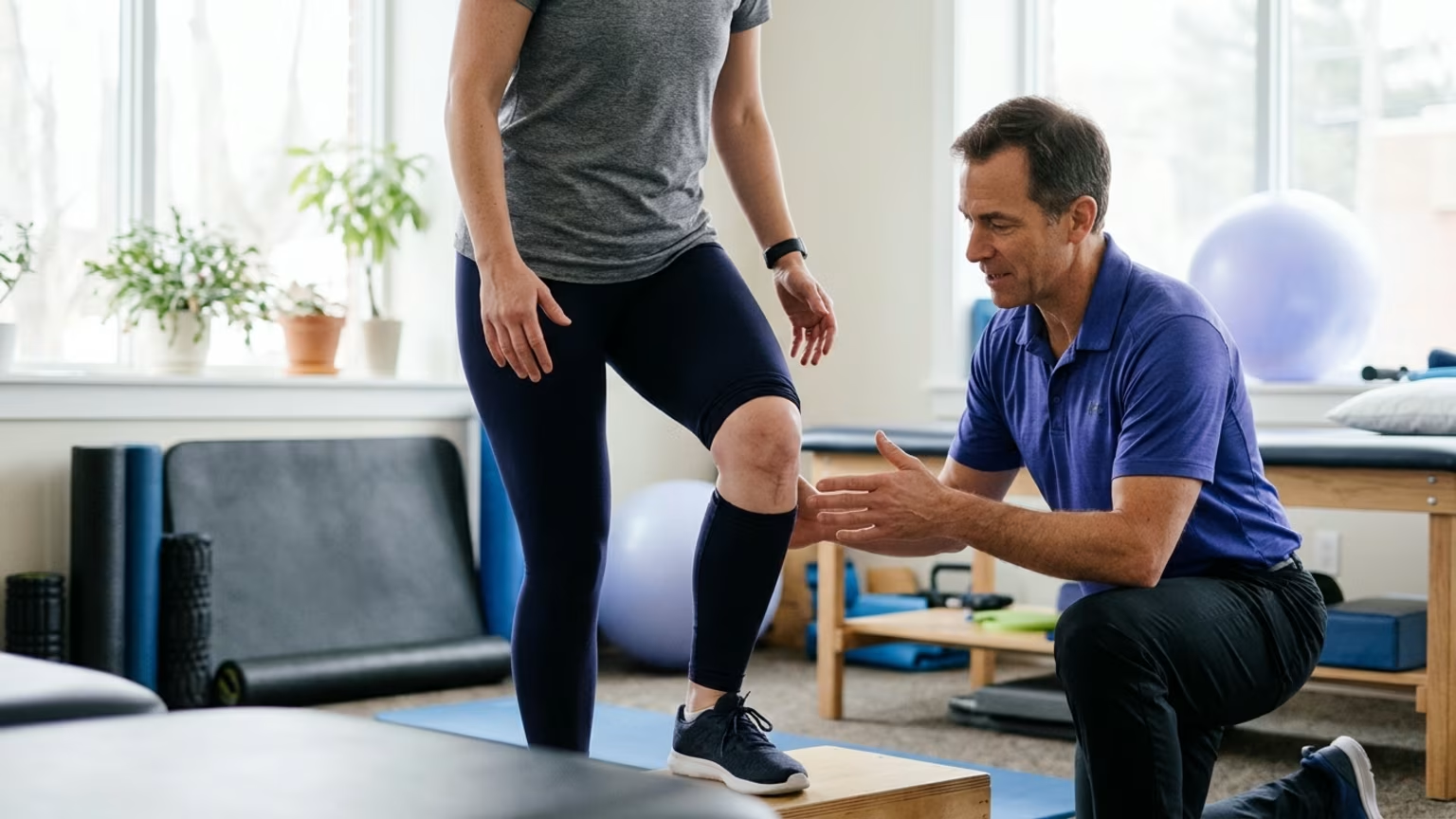
For readers rebuilding movement, the practical value is a clearer conversation about exercise selection. The article supplies names for different tasks. A treating physical therapist or other qualified clinician can help relate those tasks to support needs and current restrictions.
Questions that follow directly from the article include:
These questions keep the focus on adaptation rather than completing every item in a lifestyle article. They also make room for balance to sit alongside strengthening and other rehabilitation work. ReboundBody’s overview of how balance work fits into rehabilitation provides broader editorial context.
Pain, dizziness, recent surgery or injury, and substantial unsteadiness are reasons to seek individualized guidance before applying these suggestions. Existing clinician restrictions take precedence over general lifestyle advice. The article’s harder variations deserve particular care: less hand support, eyes-closed standing, backward heel-to-toe walking and uneven-ground walking are not necessary entry-level steps.
The research supports a stable environment and appropriate support as part of the discussion. It also supports gradual increases in challenge when the current version feels controlled and safe. For an individual recovering from injury or surgery, the treating clinician helps determine what those conditions mean in practice.
The main evidence limit is the type of publication. The Martha Stewart Living piece is expert-informed lifestyle coverage, not a clinical trial or formal rehabilitation guideline. It does not test whether its particular collection of suggestions produces a specific recovery outcome.
The stronger numerical evidence in this discussion comes from broader exercise research. WHO reports that a cited Cochrane review found an approximately 23% lower overall fall rate in the exercise trial populations. That finding concerns exercise programs, not a test of the article’s five suggestions or a promised reduction for an individual reader.
That leaves an important question about the everyday-habit approach: how does this particular collection of brief activities affect outcomes over time? The article does not establish how much each suggestion contributes or which combination works best. Those questions should remain open rather than being answered by borrowing the result from broader exercise programs.
The practical implication is to use the article for its examples and WHO’s guidance for the broader principles. The next decision is about matching movement demands to the person, not assuming that a more difficult variation is automatically a better choice.
Steady progress deserves sound evidence and care that fits the person.
Balance during standing and walking is the practical outcome these exercise suggestions aim to support. ReboundBody explains mobility and physical recovery for active adults sidelined by injury or surgery. Its editorial coverage helps readers understand recovery milestones and questions for their healthcare team without promising a particular result.

Follow ReboundBody for practical articles on injury recovery, rehabilitation, mobility and rebuilding strength. New posts turn research into clear ideas for the road back to activity after injury or surgery.




Read practical guidance on injury recovery, rehabilitation, mobility and rebuilding strength as you work your way back to activity.
Explore Resources