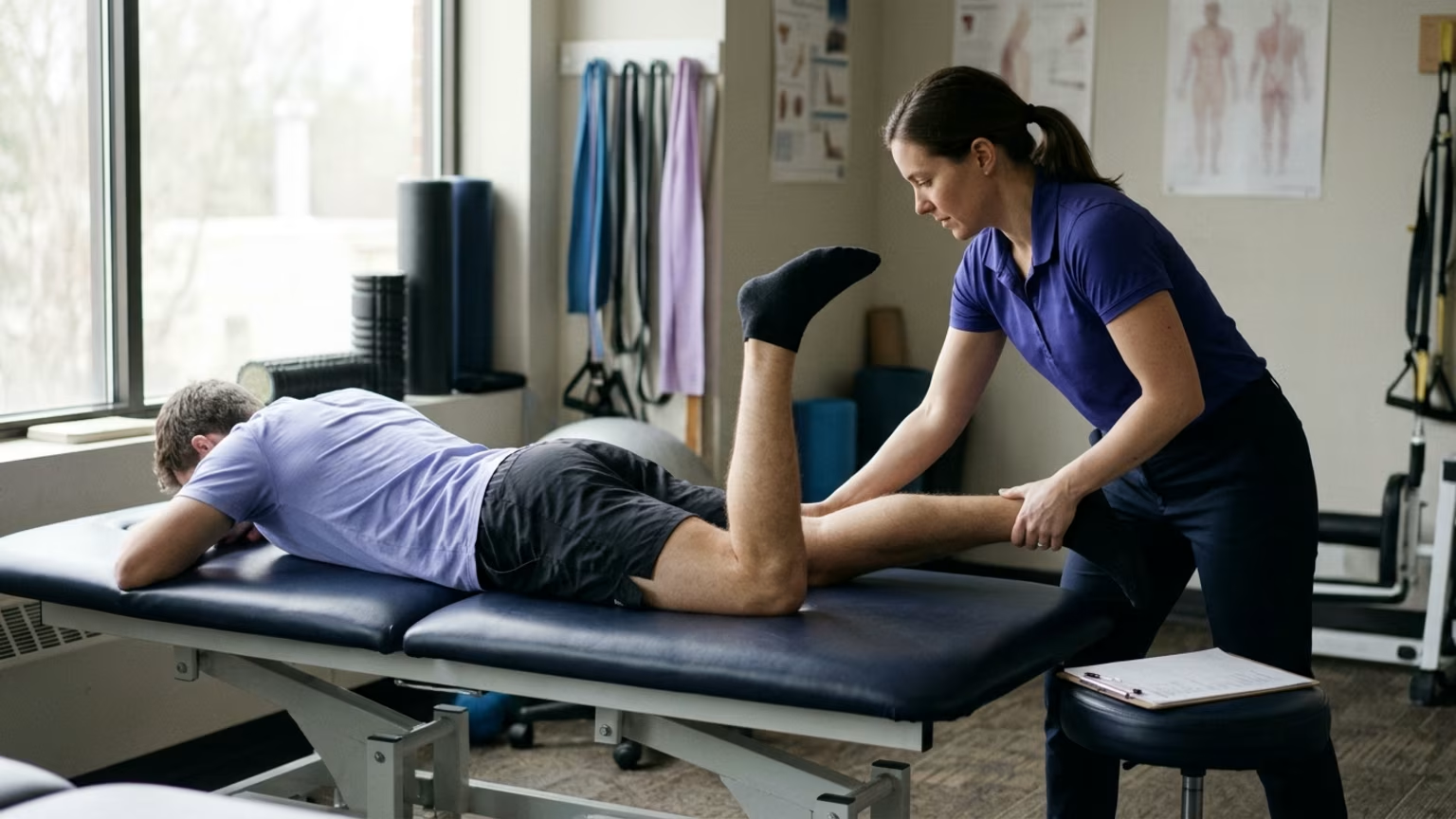

An athlete-focused hamstring consensus favors measured progress, strength assessment and sport-specific preparation. Here is its relevance and its limits.





In its November 2026 issue, the International Journal of Sports Physical Therapy published “Diagnosis, Rehabilitation, and Return to Sport after Athletic Hamstring Injury: An ICCUS Society Consensus Statement.” The expert panel supported individualized rehabilitation that connects progressive loading and strength assessment with the demands of an athlete’s sport.
A return date on a calendar is easy to name. The statement focuses instead on the findings used to support that date: symptoms, measured function and preparation for the intended activity. It places gradual running progression and readiness for sport within the same decision framework.
Developed through a modified Delphi consensus survey, the statement gathers expert views on athletic hamstring injury evaluation and rehabilitation. This structured approach identifies where panel members agree. Its central message is that progression should reflect the person’s clinical presentation and objective findings rather than elapsed time alone.
The evidence context includes a Scientific Reports paper titled “Effects of rehabilitation interventions on time to return to play and reinjury rate in athletes with acute hamstring strain injuries.” That paper’s stated focus was rehabilitation interventions and recovery outcomes.
The November consensus addresses a different part of the clinical question. It asks where experienced clinicians agree about evaluating an injury, progressing rehabilitation and assessing return to sport. Outcomes research and expert agreement serve different purposes when clinicians interpret guidance.
This distinction helps put the update in perspective. The relevant contrast is not simply old calendar-based care versus an entirely new method. It is the difference between examining recovery outcomes and bringing clinical views together into a shared framework.
For readers, the useful background question is therefore more specific than “How many weeks does recovery take?” It is also “What information supports the next stage?” The consensus organizes that information around loading, strength and the activity the athlete intends to resume.
According to the International Journal of Sports Physical Therapy statement, the authors developed 60 statements for review. Of those, 54 met the predefined consensus threshold of at least 80% agreement or disagreement on a five-point scale.
The recommendations connect several parts of rehabilitation rather than treating return to sport as a single final test.
The panel supported progressive tissue loading and restoration of tissue length. It also emphasized adjusting rehabilitation according to the clinical presentation and objective findings.
In plain language, criterion-based progression means that movement to another stage depends on relevant findings. The focus is on how the athlete is responding and what capacity has been restored. A date remains part of the recovery record rather than the sole reason to increase demands.
The panel also endorsed symptom monitoring during rehabilitation. That monitoring belongs within the broader assessment of loading and response. ReboundBody’s explanation of building activity demands gradually provides background on the idea of progressive loading.
The panel backed a gradual increase in running amount, duration and intensity toward sprinting. It agreed that running should be pain-free before sprinting. It also supported sport-specific agility work.
The intended endpoint was not simply the ability to complete a sprint. Sprint intensity and volume should reflect the athlete’s sport. The consensus therefore connects running progression with the workload that returning to participation will involve.
For return-to-sport assessment, the panel supported pain-free sprinting and a gradual increase toward game-level intensity and volume. Full unrestricted training was another consideration. Together, these recommendations describe preparation for participation rather than a calendar-based finish line.
The panel supported measuring hamstring peak force or torque. It also included kinetic-chain strength and function, which places the hamstrings within a wider movement assessment. Sport-specific strength demands were part of that evaluation.
One proposed benchmark was lower-extremity strength within 10% of previous data or population means. The statement reports 96% agreement with that proposal. The panel also supported strength benchmarks that reflect the demands of the athlete’s sport.
These recommendations place objective strength findings alongside activity demands. The assessment asks both how much strength is present and how that finding relates to the intended sport.
The panel also supported assessing readiness and apprehension. Those considerations sit beside strength testing and unrestricted training in the return-to-sport framework.
This gives the athlete’s perspective a defined place in the discussion. The clinician is considering measured capacity, exposure to sport demands and how prepared the athlete feels to return. The statement brings those elements together rather than presenting one measurement as the entire decision.
The consensus concerns athletic hamstring injuries. Panel members were selected for experience treating athletes in high-school, collegiate, semi-professional or professional settings.
That population matters for adults returning to recreational activity. The statement does not establish that its return-to-sport criteria have been validated for every recreational exerciser or for non-athletes with hamstring problems. Its athletic endpoint should not automatically become everyone’s recovery target.
Someone returning to walking or gym exercise should not infer that sprinting is required. Likewise, game-level training volume is not a universal milestone for normal daily movement. Those recommendations belong to the athletic return-to-sport setting addressed by the panel.
The broader idea is to connect assessment with the intended activity. ReboundBody’s discussion of different levels of activity return provides context for separating basic participation from full sporting performance.
For a recreational adult, the appropriate application is a discussion with a qualified clinician about which findings relate to the activity they want to resume. The goal is relevance rather than copying an athlete’s testing framework.
For readers approaching the transition out of formal rehabilitation, the consensus offers useful topics for discussion. It gives that conversation more detail than a return date alone.
Questions grounded in the panel’s recommendations include:
These questions help connect an exercise plan with its purpose. For example, a discussion about strength testing can address what is being measured and why that measure matters for the intended activity. A discussion about progression can clarify which findings the clinician will review before changing demands.
The same approach helps clarify the transition from supervised rehabilitation to independent activity. The question becomes how the remaining preparation relates to the reader’s goal. It is not simply whether the rehabilitation calendar has reached its final page.
For broader context, ReboundBody covers connecting rehabilitation with familiar hobbies and activities. Personal decisions about exercise selection and progression belong with the qualified professional who knows the injury and the person’s recovery course.
The central evidence limit is that this was an expert-consensus survey rather than a clinical trial. The authors sought agreement on clinical guidance. They did not test whether following the framework leads to faster recovery or fewer repeat injuries.
The panel was also small and drawn from the ICCUS Society. Seventeen experienced clinicians completed the final round. That selection may limit the range of perspectives represented among sports-medicine practitioners.
Agreement did not extend to every proposed return-to-sport measure. The panel did not reach consensus on a standard hamstring-to-quadriceps ratio, specified range-of-motion percentages or EMG force-decay rates. Panel comments raised questions about testing methods and sensitivity as well as limb dominance and relevance to the sport.
A measure failing to reach consensus is not the same as proof that it has no value. It means the panel did not provide shared support for its proposed use. Likewise, an endorsed strength benchmark is not a validated stand-alone clearance test.
The authors identified further research questions. These include how injury classification should inform return-to-running timeframes and which functional tests best determine safe return to sport. Those questions remain important when interpreting the framework.
The practical takeaway is to use the statement to structure a clinical conversation around measured progress and relevant demands. It brings useful order to that discussion while leaving outcome benefits and the best testing choices unresolved.
The November journal issue puts a date on the guidance. The guidance itself points away from choosing a return date in isolation. On the recovery calendar, the date gains meaning when it is connected with measured strength, preparation for the intended activity and readiness to return.
Planning the move from hamstring rehabilitation to regular activity is where ReboundBody’s editorial coverage adds broader recovery context. When the end of formal rehabilitation leaves an active adult unsure about returning to familiar pursuits, the site’s clear explanations of mobility and strength rebuilding help make the next healthcare conversation more informed.

Follow ReboundBody for practical articles on injury recovery, rehabilitation, mobility and rebuilding strength. New posts turn research into clear ideas for the road back to activity after injury or surgery.






Read practical guidance on injury recovery, rehabilitation, mobility and rebuilding strength as you work your way back to activity.
Explore Resources