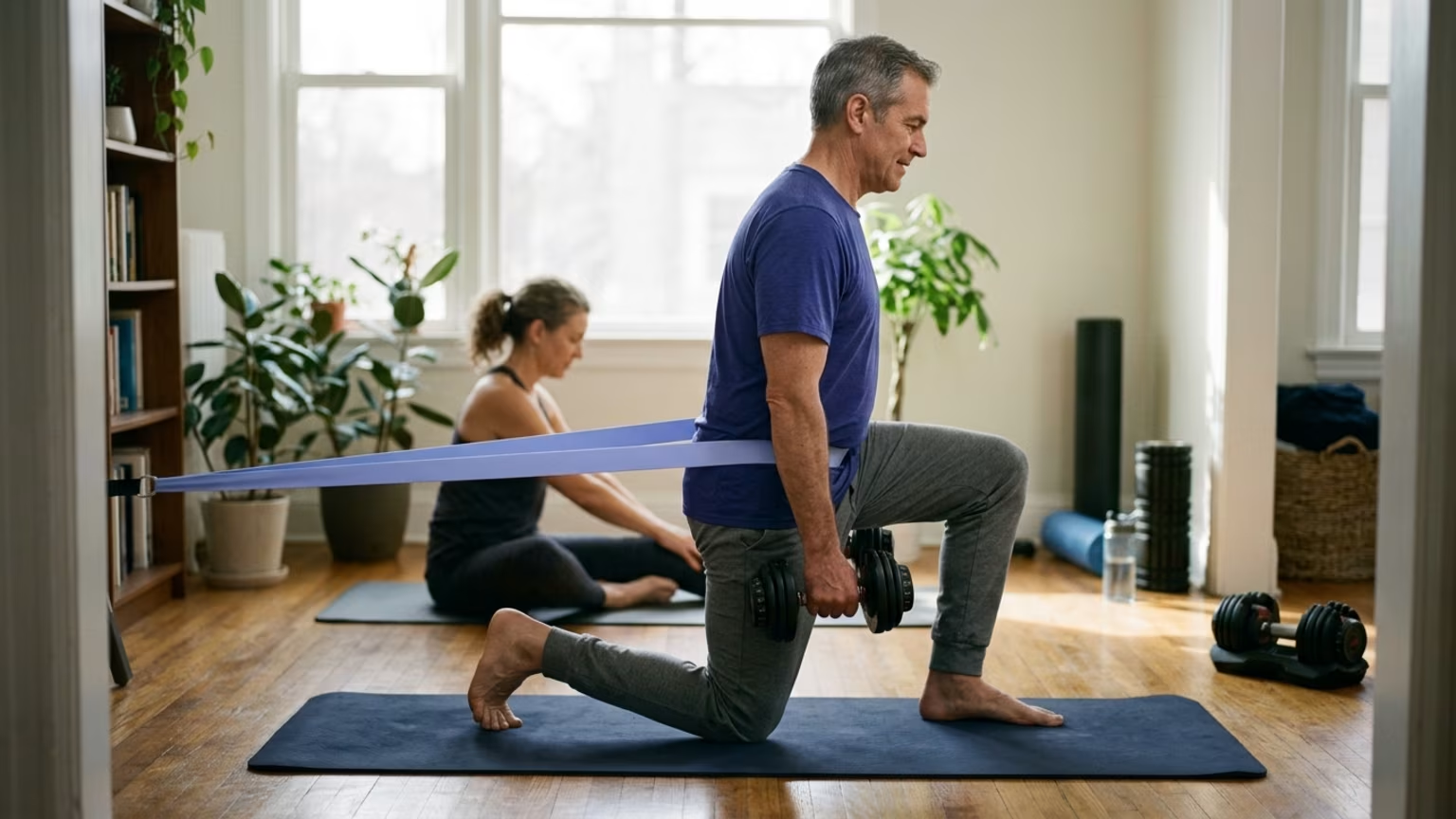

A fitness feature highlights a four-move banded hip routine. Learn how active adults can safely interpret general exercise advice and adjust physical loads.





On October 6, 2026, Tom’s Guide published an opinion feature outlining a specific exercise routine. Fitness editor and coach Sam Hopes shared a program she designed for a 55-year-old woman. The client wanted a short mobility routine she could perform at home. The resulting program requires only an exercise mat and a thick loop band.
Hopes structured the session to target hip strength and movement explicitly. The feature presents one professional coach's approach to building a targeted home workout. It offers a practical look at how fitness professionals design programs for active adults. These adults often seek clear ways to maintain their physical capacity at home.
When active adults search for ways to support their lower body joints, they usually encounter highly repetitive workout templates. These templates often prioritize large movements designed to build general muscle mass. Exercises like the squat or the lunge dominate the typical fitness landscape. While these movements are excellent for general strength, they primarily move the body in a single plane of motion.
The human hip is a complex joint designed for multidirectional movement. It requires targeted work across various angles to maintain its full functional capacity. If a physical routine only trains the hip to move straight up and down, the supporting muscles can become unbalanced. This lack of varied movement can lead to feelings of stiffness during normal daily activities.
The Tom's Guide article highlights this gap in traditional programming by introducing a more varied approach. According to the feature, comprehensive hip work should include rotation and force production. The article also lists adduction, abduction, stabilization, and control as key elements. Rotation involves twisting the leg inward or outward at the hip joint.
Adduction brings the leg toward the center line of your body, while abduction moves it away. These specific functions are crucial for tasks like stepping out of a car or maintaining balance on an uneven surface. By shifting the focus away from just squats and lunges, the routine attempts to address these often-neglected movement patterns. This broad view of hip function is essential for comfortable everyday movement.
The featured routine consists of four specific exercises selected to challenge different hip muscle groups. The sequence begins with banded clamshells paired with a knee drive. This is followed by kneeling abductions, which force the hips to work against resistance from a grounded position. The program also incorporates banded internal rotations and overhead hip-flexor stretches to round out the session.
Hopes intentionally categorizes these four movements as intermediate exercises. The programming sets clear volume expectations for each specific movement in the routine. For the clamshells and the overhead stretches, the article prescribes two to three sets of six to ten repetitions per side. This volume is intended to create a moderate challenge without completely exhausting the muscle tissues.
For the kneeling abductions and the banded internal rotations, the prescribed volume is slightly lower. The author recommends two to three sets of six to eight repetitions per side for these two movements. These distinct repetition targets provide a structured framework for the workout. They differentiate the session from a casual stretching routine.
A major focus of the article is the importance of adjusting the physical load during the workout. The author explicitly advises readers to start the routine slowly to gauge their physical response. If the initial volume feels too demanding, she suggests reducing the number of sets or repetitions. Comparing strength training methods highlights how crucial this adaptability is for long-term progress.
Users are also encouraged to change the resistance band to suit their personal comfort and current strength level. Beyond simply changing bands, the feature suggests several other methods to modify the exercise intensity. A user might optionally add external weight, include brief pauses at the top of a movement, or introduce small pulses. The article also notes that slowing the tempo of the exercise is an effective way to increase the overall intensity.
It is critically important to recognize the intended audience for this specific mobility routine. The article details a program that was designed explicitly for one 55-year-old female client. It is presented as a client-specific example developed by a Level 3 qualified trainer. It is not intended to serve as a universal prescription for every adult experiencing hip stiffness.
Hopes shares her programming decisions as professional coaching choices rather than medical directives. The routine is not a clinical rehabilitation plan aimed at treating a particular orthopedic diagnosis. Furthermore, it is not designed to guide patients through a specific post-operative stage of joint recovery. The benefit claims and movement selections come entirely from the author's individual coaching experience.
Notably, the feature does not directly quote any external clinical expert to validate the exercise sequence. Readers must understand the fundamental difference between an opinion piece and peer-reviewed clinical guidance. A fitness coach can design an excellent routine for a healthy client, but that does not make it a medical protocol. Active adults must maintain this perspective when evaluating new fitness trends.
Exercises designated as intermediate require a solid foundation of joint stability and baseline strength. People who are currently recovering from a joint injury may not possess this necessary foundation yet. Applying an intermediate training program too early in the recovery process can severely irritate healing tissues. Readers must honestly assess their current physical capacity before attempting new resistance work.
Readers who are returning to physical activity after a setback should approach these repetition targets carefully. You should never treat a published set and repetition scheme as a mandatory personalized target. A general fitness article cannot account for your unique injury history or current joint tolerance. Forcing your body to hit a predetermined number of repetitions can cause you to ignore vital physical warning signs.
The article provides highly specific safety guidelines that readers must take seriously. It clearly advises individuals to stop immediately and seek medical advice if pain or feeling unwell occurs during the routine. Experiencing standard muscle fatigue is normal, but encountering sharp joint pain is a clear warning signal. Respecting these boundaries is a central component of scaling training without rushing.
Additionally, the feature offers an essential safeguard for anyone managing a complex physical background. It explicitly recommends seeking professional medical advice before starting the routine if you have an existing injury or health condition. A qualified healthcare professional can help you determine if banded hip exercises are safe for your specific situation. They can also provide necessary modifications to protect vulnerable joints during the movements.
Adjusting the exercise load is a highly practical element of the author's coaching philosophy. However, having options to adjust the resistance does not guarantee the routine is completely safe for everyone. Dropping to a lighter band might alleviate discomfort for one person, while another might need to avoid the movement entirely. You must evaluate these flexible coaching tools alongside your own clinical recovery guidelines.
The evidence supporting this exact combination of exercises remains entirely narrow in scope. The primary source for these claims is a single opinion feature written by a fitness editor. Comprehensive reviews of recent literature did not surface independent clinical research validating this exact four-move sequence. There is also no broad scientific data confirming the optimal dose or the long-term clinical effects of this specific routine.
Fitness features consistently provide valuable insight into how professionals design programs for healthy adults. They do not, however, establish new medical standards for orthopedic rehabilitation or physical therapy. The fitness media landscape frequently highlights novel variations of resistance band workouts and mobility drills. These articles generally reflect evolving coaching preferences rather than fundamental shifts in established medical consensus.
Navigating the transition from formal clinical rehabilitation back to independent exercise often involves significant uncertainty. A general fitness article, no matter how well-designed, cannot replace an individualized assessment from a physical therapist. Clinicians evaluate your specific joint mechanics, measure your functional load tolerance, and map out your personal recovery timeline. This critical level of customized medical guidance simply cannot be provided through a general fitness feature.
As you encounter new exercise routines online, remember to separate coaching inspiration from medical instruction. If you decide to test a new movement you read about, perform a single set of three repetitions using only your body weight first. This step ensures the basic motion does not trigger any joint pain before you add resistance bands.
Evaluating how to adjust the load and volume of an intermediate fitness routine requires clear judgment, and ReboundBody provides the context needed to make those decisions safely. We address the uncertainty about the transition from formal rehabilitation back to normal activity, helping you build strength without rushing your recovery.

Follow ReboundBody for practical articles on injury recovery, rehabilitation, mobility and rebuilding strength. New posts turn research into clear ideas for the road back to activity after injury or surgery.




Read practical guidance on injury recovery, rehabilitation, mobility and rebuilding strength as you work your way back to activity.
Explore Resources