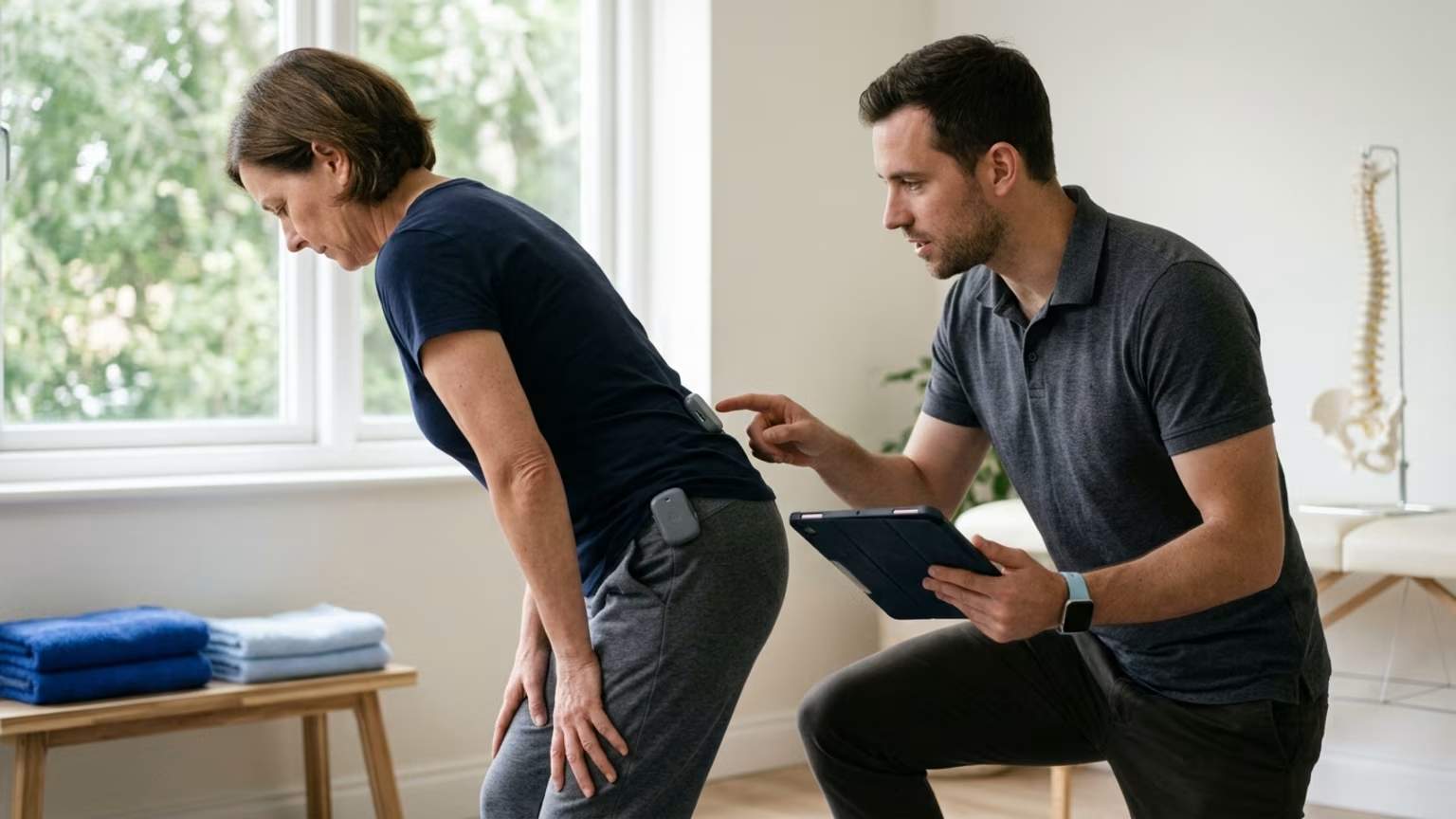

A 2026 study asks if inclinometers can measure movement quality during planks for adults with low back pain. Learn how guarding affects clinical tests.





On October 1, 2026, the International Journal of Sports Physical Therapy published new research on trunk stabilization. The study evaluated digital-inclinometer measurements during plank tests for active adults with and without low back pain. Researchers sought an objective way to quantify movement deviation rather than relying strictly on patient pain reports. They found that participants with low back pain actually showed smaller movement deviations during side planks. This early measurement study investigates whether clinicians can accurately track trunk stability alongside standard hold times.
Tracking physical progress during recovery often requires precise measurement tools. Physical therapists need data to adjust treatment plans safely over time. This recent study provides insight into how the body changes its stabilization strategies when dealing with pain. It highlights a common clinical challenge of separating movement quality from simple physical endurance. For active adults navigating recovery, this research offers a closer look at how compensatory patterns develop.
Clinicians have long used timed plank tests to assess trunk performance during orthopedic rehabilitation. A patient typically holds a forward or side plank until they can no longer maintain the proper position. The assessor then records the total time to failure as a clinical measure of core endurance. This metric provides a simple number to track across multiple clinical visits over time.
However, the study authors note that timing alone does not capture compensatory patterns or subtle movement quality. A person might endure a plank for a full minute while using poor body mechanics. They might shift their weight, alter their spine position, or brace awkwardly to avoid pain. This creates a gap in understanding how a patient actually controls their body during exercise.
Broad clinical guidelines consistently highlight the importance of active movement for physical recovery. A 2026 multidisciplinary guideline review in Pain Medicine provides valuable clinical context for this approach. The extensive review reports moderate-confidence evidence for early physical-therapy referral that includes a specific exercise focus. It also supports broad clinical advice for patients to stay active during their recovery process.
The same 2026 review reports mixed results across exercise-specific trials for acute low back pain. It found that early physical-therapy referral improved pain and function compared with usual care. However, the review clearly noted that improvement was generally small for most tested interventions. It also stated that early imaging did not improve outcomes for acute low back pain without signs of serious spinal pathology.
Evaluating the quality of physical exercise remains a persistent clinical challenge. Standard assessments often struggle to separate a patient's physical capacity from their subjective pain experience. Practitioners need reliable ways to measure how well the trunk stabilizes during daily movement. Objective tools are necessary to help patients focus on restoring everyday function without relying purely on subjective feeling.
The new study tested a specific digital tool to address this measurement gap in physical therapy. Researchers attached a digital inclinometer to a harness worn securely on each participant's trunk. They carefully measured the maximum angular deviation from a self-identified neutral spine position. This detailed tracking occurred during both forward and side plank tests for all participants.
The final results revealed distinct differences in how people physically stabilize their bodies during exertion. On the first side-plank attempt, the group with low back pain recorded a mean deviation of 4.8 degrees. The group without low back pain recorded a significantly higher mean deviation of 7.7 degrees. This was a statistically significant difference between the two studied groups.
Interestingly, the two groups did not differ significantly in their actual plank endurance. The mean side-plank time was 55.9 seconds for those individuals with low back pain. Participants without low back pain averaged 64.3 seconds during the exact same side plank. The forward-plank hold times were also remarkably similar, at 99.2 seconds and 105.1 seconds respectively.
The forward-plank deviation difference between the two groups was not statistically significant. The study showed good reliability when the exact same assessor repeated the digital measurement. The intra-rater reliability was good, with ICCs of 0.85 for forward planks and 0.81 for side planks. This indicates measurement consistency when one professional tracks the same patient across multiple clinical attempts.
However, measurement agreement between different assessors was more limited overall. The overall inter-rater ICC was 0.66 for the forward plank and 0.61 for the side plank. This lower inter-rater reliability was especially clear within the low back pain patient group. The authors suggest that repeated physical assessments by the same clinician may be much more consistent for people with back pain.
It is vital to recognize the highly specific population studied in this clinical research. The study included exactly 34 active adults between the ages of 18 and 40. There were 17 participants with low back pain and 17 participants without it. The mean age of the overall participant group was 25.6 years.
This was a highly active and generally healthy group of young adults. Participants reported doing vigorous exercise about 5.3 days per week on average. The participants with low back pain also had relatively low average pain and physical disability scores. This mild symptom profile likely explains why their plank endurance closely matched the healthy group.
Because of these narrow criteria, the findings do not generalize broadly to the wider population. The authors explicitly caution that these results may not apply to older adults. They also may not represent people who are less active or those with severe low back pain. Patients in their 40s through 70s should not assume these specific patterns apply directly to them.
Age and activity levels change how the body responds to spinal loading. Older adults recovering from surgery often face entirely different mobility restrictions than young athletes. Research must validate these tools across diverse age groups before they become standard clinical practice. Until then, these findings serve as early data for a very specific athletic demographic.
For people returning to physical activity, these findings separate movement behavior from simple hold time. A smaller movement deviation might sound like a positive physical result at first glance. However, a smaller movement deviation is not automatically a sign of better athletic form. It simply means the trunk physically moved less during the stabilization test.
The study authors suggest that the smaller side-plank deviation could reflect a more guarded stabilization strategy. People experiencing physical pain often adopt protective stiffness to avoid discomfort during physical exertion. The researchers strongly caution that this rigidity does not necessarily mean more efficient motor control. Guarding is a common physical response when the body senses an area of physical vulnerability.
This highlights a frequent daily reality during orthopedic rehabilitation. The human body finds novel ways to protect a healing joint or an irritated nerve. Relying strictly on physical stiffness might help in the short term, but it can permanently alter natural mechanics. Returning to normal physical activity requires restoring fluid movement, not just locking joints in place. Meeting objective physical benchmarks is often more important than simply eliminating immediate joint discomfort.
Readers should treat this specific study as a measurement finding, rather than a new exercise prescription. The published article does not test whether plank training actually improves joint pain or functional capacity. It simply asks how clinicians might better record physical movement quality during a standard clinical assessment. Discuss any new core exercise variations with your healthcare team to ensure personal physical safety.
While the digital inclinometer shows clinical promise, several important medical questions remain open. The study did not establish criterion validity against a gold-standard motion-analysis system. The inclinometer device only captured physical movement in one single plane for each plank test. The authors actively recommend future comparison with three-dimensional motion analysis to accurately verify clinical accuracy.
The measurement consistency also presents real practical challenges for widespread clinical use. The lower inter-rater reliability means the method is not a universally interchangeable clinical measurement. A single clinician tracking a specific patient over time may see highly consistent physical results. However, switching physical therapists mid-recovery could alter the clinical readings significantly.
Furthermore, the significant side-plank physical result only appeared on the very first attempt. It did not appear on the second testing attempt during the clinical study. The authors point to possible muscle fatigue effects and side-testing differences as important interpretative caveats. These physical variables greatly complicate how a clinician might confidently use the testing tool in a busy practice.
Measuring human movement remains a highly complex and rapidly developing field of clinical research. Objective clinical data can properly guide rehabilitation, but it must be viewed in proper medical context. Clinical mobility assessments will likely continue to evolve as dedicated researchers test and refine new diagnostic tools. More clinical studies are needed to determine if these specific measurement tools actually improve long-term patient recovery outcomes.
Understanding how your body compensates during exercise is an ongoing process. As objective measurements improve, patients and practitioners can build more detailed recovery plans. Focus on steady progress, communicate openly with your clinical team, and respect your current physical limits.
Choosing whether to track subtle movement deviations or focus strictly on physical endurance during a plank test alters how you gauge your recovery progress, and ReboundBody helps clarify these measurement choices. We resolve the difficulty understanding clinical terminology and research findings, helping you confidently interpret signs of protective guarding before your next physical therapy session. Browse Resources

Follow ReboundBody for practical articles on injury recovery, rehabilitation, mobility and rebuilding strength. New posts turn research into clear ideas for the road back to activity after injury or surgery.




Read practical guidance on injury recovery, rehabilitation, mobility and rebuilding strength as you work your way back to activity.
Explore Resources