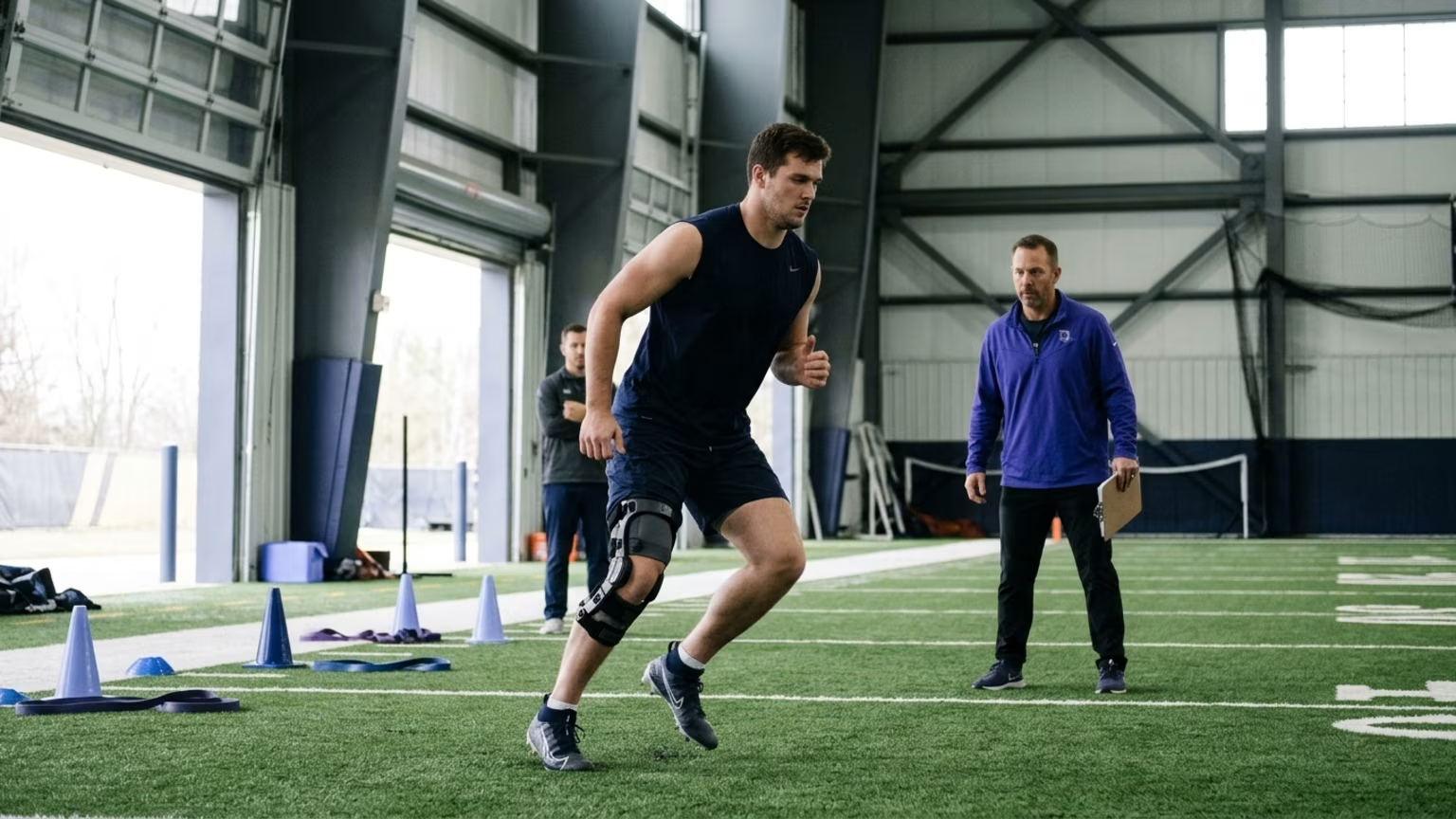

Tyrell Shavers’ limited practice return offers context for understanding ACL recovery milestones, activity demands and questions for a treating clinician.





The Buffalo Bills reported on 2026-10-29 that wide receiver Tyrell Shavers had returned to practice as a limited participant after ACL surgery. A 2026-10-28 injury report also described the opening of his 21-day practice window. That window gives the team an opportunity to evaluate him before deciding whether to activate him.
The official account said Shavers had gone 290 days without practicing. He said it felt good to return and that he needed to “knock some rust off.” His first practice back marked a change in participation rather than an announcement of game readiness.
For adults rebuilding activity after orthopedic surgery, that distinction deserves attention. A return headline describes a milestone. Understanding the milestone means asking what activity resumed and what decision still lies ahead.
Before this update, Shavers had been on the physically unable to perform list after ACL surgery in late January. The Bills’ account says he tore his ACL during the January playoff game against the Jacksonville Jaguars. The new development was his return to limited practice after that absence.
The relevant medical context is broader than a roster designation. Cleveland Clinic describes return-to-play decisions after substantial injuries as an ongoing process rather than a single clearance visit. Its account considers recovery and function alongside the demands of the sport. Reinjury risk and potential long-term consequences also belong in that process.
That framework helps explain why a date and an assessment answer different questions. A date tells us how much time has passed. An assessment addresses how recovery and function relate to the activity being considered.
The distinction also changes how to read the word “return.” Returning to a practice setting is one event. Deciding about competition is another decision within the wider process. The useful context is therefore not a universal countdown, but a continuing assessment of recovery and the task ahead.
The practice window creates a period for the Bills to evaluate Shavers before an activation decision. Its length describes that roster process. It is not a published medical target for completing ACL rehabilitation.
Three terms in this story deserve separate attention:
Keeping those terms separate prevents a roster announcement from sounding like a statement about full recovery. It also preserves what the update actually adds: Shavers was participating again within a defined evaluation period.
The same injury report listed Spencer Brown as not practicing. DJ Moore and Ed Oliver were among the players listed as limited after the bye week.
Those entries show different participation statuses following the same scheduled break from competition. The report’s encouraging tone about some players was commentary rather than a clinical determination of readiness.
The useful comparison is between the statuses themselves. One player had an opportunity to resume limited practice while others remained limited or out of practice. A shared place on the schedule did not produce a shared participation status.
The Bills’ account concerns a professional wide receiver returning after ACL surgery. Cleveland Clinic’s discussion is framed around injured Division 1 athletes. Those are the athletic settings represented by the sources behind this update.
For adults returning to exercise or recreational sport, the useful connection is the decision-making framework. Recovery, function and the demands of the intended activity are relevant topics for a conversation with qualified care. The professional-football setting does not have to become the reader’s model for recovery.
A helpful distinction is between borrowing a question and borrowing an answer. “What does this participation status mean?” is a useful question. Another athlete’s practice date is an answer about that athlete’s experience.
ReboundBody’s explanation of how activity readiness is assessed offers related context for understanding assessment language. The aim is to understand what a milestone represents within a person’s own recovery discussions rather than to match a public sports update.
The practical value of this story is a clearer way to discuss progress. Cleveland Clinic’s framework supports looking at function and activity demands alongside recovery and risk. That creates more useful questions than asking only how many days have passed.
These questions can help organize a discussion with a treating clinician. They are conversation topics rather than a self-clearance checklist.
A label such as “limited” needs context. In Shavers’ case, it identifies his reported practice status. In a personal recovery conversation, the useful question is what the current stage means for the activity under discussion.
This keeps a general phrase such as “back to activity” from carrying more meaning than intended. It also makes room to distinguish the present stage from a later decision about competition.
Cleveland Clinic includes function in the return-to-play process. Asking how function is being evaluated keeps the conversation connected to assessment rather than to a calendar alone.
For readers still in rehabilitation, understanding what physical therapy evaluations and progress reviews involve can provide context for that discussion. A public athlete update and an individual progress review serve different purposes.
The intended activity belongs in the conversation because Cleveland Clinic identifies sport demands as part of return-to-play decisions. The question is not simply whether someone has returned to movement. It is what that person is preparing to do.
That distinction is also central to understanding the transition from rehabilitation toward sport readiness. Naming the intended activity gives the discussion a clearer purpose.
Cleveland Clinic includes reinjury risk and potential long-term consequences in its account. These topics belong beside progress rather than being treated as separate concerns.
The practical goal is understanding the reasoning behind the next decision. It is not finding a public milestone that appears to authorize the same step for everyone.
The Bills’ official account does not provide clinical test results or a return-to-sport clearance protocol. It also gives no promised date for game participation. The public update therefore leaves the clinical basis for Shavers’ next participation decision unresolved.
His 290 days without practicing describe his own timeline. That figure does not establish a typical or recommended return point for another person after ACL surgery. The sources also lack enough clinical detail to compare his rehabilitation and readiness with another patient’s situation.
The post-bye injury report has a separate limit. It shows varying participation statuses after a break, but it does not establish that a fixed period of rest restores readiness on its own. Rest on the schedule and readiness for a particular task are different pieces of information.
The clearest use of this news is therefore to improve the question being asked. Instead of treating time away as the deciding fact, the conversation can focus on how recovery and function relate to the next activity. That leaves personal decisions with the professionals who can assess the individual situation.
Today, write down one question for your treating clinician: “What assessment will guide my next step toward the activity I want to return to?”
Practice restrictions and sport clearance are matters for the rehabilitation team, with ReboundBody serving as a separate source of recovery education. For adults in midlife and later life, its evidence-aware articles put conflicting exercise and treatment claims in context to support better-informed conversations with qualified healthcare professionals.

Follow ReboundBody for practical articles on injury recovery, rehabilitation, mobility and rebuilding strength. New posts turn research into clear ideas for the road back to activity after injury or surgery.





Read practical guidance on injury recovery, rehabilitation, mobility and rebuilding strength as you work your way back to activity.
Explore Resources