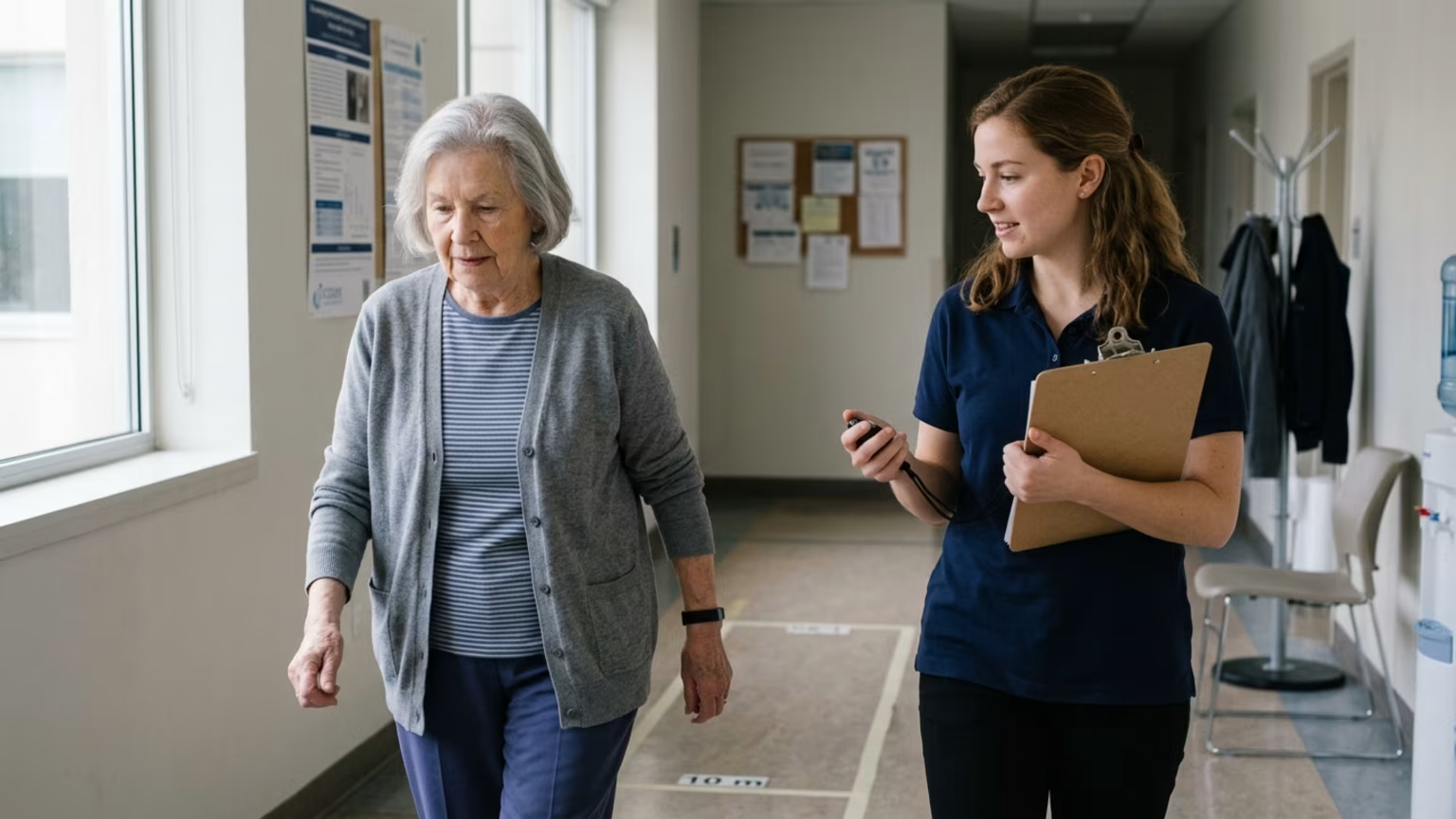

A recent PLOS ONE trial suggests faster-paced walking may help reverse frailty in older adults. Learn how to safely manage walking intensity and movement.





On September 30, 2026, TIME reported on a clinical trial published in the journal PLOS ONE. The study examined how different walking speeds affect older adults living in retirement communities. Researchers compared a higher-intensity walking program directly against a casual-speed walking routine. The trial aimed to see if changing the effort level could impact physical decline. Both groups eventually showed improvement on standard frailty measures. However, the data revealed that improvement was more common in the higher-intensity group.
This recent report provides a helpful look at how the body responds to increased physical demand. Movement routines for older adults often prioritize safety through slow and steady pacing. The PLOS ONE trial introduces new questions about whether slightly more vigorous effort could yield better results. Measuring frailty involves tracking specific physical categories over a set period of time. By testing two different intensities, researchers gathered new evidence on how movement variables affect aging.
The concept of pushing harder during exercise is often intimidating for active adults. Many people worry about the risks of doing too much too soon. The findings offer a specific example of how controlled intensity might be applied in older populations. This adds valuable information to the ongoing conversation about active aging and physical longevity.
The study highlights a recurring debate in the fields of geriatrics and physical rehabilitation. Medical professionals constantly weigh the benefits of movement against the risk of falls or joint stress. Finding the right balance is crucial for maintaining independence in later life. This new data suggests that walking slightly faster could be a useful tool for preventing further decline.
Historically, medical and rehabilitation guidelines have favored highly conservative movement plans for frail individuals. There is often a widespread fear of causing a fall or triggering a new injury. Because of these concerns, exercise programs for older adults frequently remain at a low intensity. Margaret Danilovich is a physical therapist and a Northwestern University instructor who co-authored the study. She noted that assuming a frail person should not be asked to do much can be a miscalculation.
Standard physical therapy protocols usually follow this cautious approach. Sara Espinoza is a Cedars-Sinai geriatrician who was not involved in the trial. She stated that physical therapy does not typically involve high-intensity exercise that raises heart rate. Routine care focuses heavily on basic functional tasks rather than vigorous cardiovascular effort. This cautious baseline has shaped how most older adults view their own physical capabilities.
The reluctance to push frail adults is deeply rooted in traditional medical training. Healthcare providers are rightly cautious about prescribing strenuous activity to individuals with multiple health conditions. This cautious approach often transfers directly to the patients, who learn to view exercise as a potential hazard. Over time, this mindset can lead to a gradual loss of muscle mass and cardiovascular endurance.
For many people, the transition from formal rehabilitation back to normal activity is confusing. Without guidance to increase effort, many individuals stick strictly to casual walking speeds. They may avoid pushing their limits because they lack clear evidence that doing so is safe. This conservative mindset often keeps people stuck in a cycle of movement avoidance. It limits the natural rebuilding of physical strength that comes from gradual progression.
The PLOS ONE trial introduces specific statistical evidence regarding the benefits of walking faster. The article reports that nearly 70% of participants in the higher-intensity group improved in at least one frailty category. In comparison, only 46% of the people in the casual-walking group saw similar improvements. This significant difference suggests that the level of effort plays a direct role in physical recovery. Both groups benefited from moving, but the faster pace yielded higher rates of positive change.
To achieve these results, the research team implemented a highly structured coaching environment. The trial required participants in the higher-intensity group to reach a specific physical threshold. The research team aimed for vigorous activity, which they defined as more than 70% of maximum heart rate. To maintain this level of effort, coaches used verbal prompts when participants slowed down. This continuous encouragement helped the walkers sustain a challenging pace throughout their sessions.
Despite the increased cardiovascular demand, the physical tasks remained quite basic. Both groups did similar walking tasks during the trial. These exercises included walking forward and backward, with and without walkers. The primary difference was simply the speed and intensity of the movement. Espinoza said the findings were interesting because they suggest higher-intensity exercise may be safe for this population. She supported this by noting that only one fall occurred during the study.
It is important to recognize exactly who participated in this trial to understand its realistic limits. The study took place across 14 different retirement homes. Research assistants assessed participants for frailty directly in these residential environments. They also coached the walking sessions in the familiar hallways of the communities. This controlled setting provided a flat and predictable surface for the older adults to navigate.
The trial specifically focused on residents of these retirement communities who were experiencing frailty. The results reflect the responses of this particular demographic under supervised conditions. The trial’s reported improvement rates do not establish that faster walking is appropriate for every individual. The article describes a specific intervention delivered in retirement-home settings rather than a general rehabilitation protocol. It does not provide a universal set of instructions for the general public.
People recovering from a recent surgery or a sudden injury face entirely different physical challenges. The hallway walking tasks were supervised by research assistants who monitored the participants closely. This level of oversight is rarely available to someone walking alone in a public park. Therefore, the outcomes apply most directly to older adults in structured residential programs. They do not automatically translate to an independent adult managing a complex orthopedic recovery alone.
For readers looking to rebuild their mobility, this study offers a helpful new perspective. The defensible takeaway is that pace or effort may be a modifiable part of your walking routine. Adjusting how fast you walk is one way to gradually challenge your body. This concept aligns perfectly with understanding how to build a walking routine safely. You can view your walking speed as a flexible tool rather than a rigid requirement.
Adding intensity to a walking program requires careful thought and clear communication with a professional. You should discuss pace as a potential training variable with a qualified healthcare provider. They can help you determine if your body is ready for higher heart rates. Before you increase your speed, you might need to establish better baseline stability. Working on foot function and mobility can support a steadier stride as you push harder.
The findings support the idea of gradually adding pace or intensity when it is appropriate and safe. This gradual progression is a fundamental concept in active aging and injury recovery. It is also important to balance cardiovascular effort with muscular stability. Learning about strength training and walking can clarify how different exercises complement your overall recovery. By managing your training load carefully, you can improve your physical capacity without overexerting yourself.
Improving physical function often involves navigating uneven surfaces and real world environments. The study took place in flat hallways, which removes many common outdoor obstacles. If you plan to increase your pace outside, you must be aware of your surroundings. Reading about walking outdoors in changing conditions can help you prepare for uneven sidewalks and weather changes. Safety should always come before speed when you are rebuilding your confidence.
Eventually, returning to normal movement means adapting your routine to fit your daily life. This includes staying active during busy seasons or when your schedule changes abruptly. Maintaining your physical progress requires consistency above all else. Finding ways to manage holidays and recovery ensures that your walking habits remain intact year round. A steady and sustainable approach is always better than rushing into vigorous activity unprepared.
It is also helpful to recognize that your body’s readiness for intensity can change from day to day. Some mornings you may feel energetic enough to walk briskly for twenty minutes. On other days, a casual pace might be all your joints can comfortably handle. Listening to these daily fluctuations is a core part of managing your long term recovery.
While the trial offers encouraging numbers, several important limitations require careful consideration. Kenneth Rockwood is a Dalhousie University professor of medicine who was not involved in the study. He cautioned that more participants dropped out of the higher-intensity group. Rockwood noted that this higher dropout rate makes it harder to generalize the findings to typical older adults. This detail suggests that the vigorous pace was simply too difficult for some participants to maintain.
Translating these supervised trial methods into routine medical care may also prove very difficult. Espinoza cautioned that this type of exercise training is not generally reimbursed by insurance providers. Without financial coverage, most older adults cannot access the daily coaching required to safely elevate their heart rates. Physical therapy clinics rarely have the resources to provide ongoing cardiovascular walking programs. This systemic barrier leaves a gap between what research shows and what patients can actually access.
There are also clear limits on how to interpret the positive results of the trial. The reported outcome is an improvement in at least one frailty category for the participants. This metric should not be rewritten as proof that the participants were no longer frail. It certainly does not mean they regained full physical function or recovered from an orthopedic injury. The study’s coaching and verbal encouragement are vital parts of the reported intervention. They do not show that unsupervised attempts to reach a vigorous heart rate are safe for all readers.
Researchers acknowledge that more work is needed to fully understand how pacing affects different populations. The report says the researchers hope to extend their work to healthy older adults using smart watches. They want to explore how wearable technology might prompt people to walk faster in their daily lives. Rockwood also welcomed research aimed at preventing frailty, while noting that more research is clearly needed. Until those studies are completed, guidance on walking intensity will continue to evolve.
The article frames the trial as evidence relevant to the broader question of appropriately challenging exercise. It helps clarify whether pushing older adults with frailty can yield positive physical changes. However, it is not a direct prescription for every older adult or every rehabilitation patient. The transition from formal medical care back to independent activity remains a highly individualized process.
Progress often relies on finding the narrow space between doing too little and pushing too hard. Small adjustments in effort can ripple outward, changing the long trajectory of physical decline.
Deciding when to increase the intensity of a daily walking routine often causes anxiety for active adults, and ReboundBody takes over the task of translating complex trial data into clear recovery concepts. We help you overcome the fear of reinjury or doing too much too soon, guiding you toward a safer return to movement with realistic expectations.

Follow ReboundBody for practical articles on injury recovery, rehabilitation, mobility and rebuilding strength. New posts turn research into clear ideas for the road back to activity after injury or surgery.





Read practical guidance on injury recovery, rehabilitation, mobility and rebuilding strength as you work your way back to activity.
Explore Resources