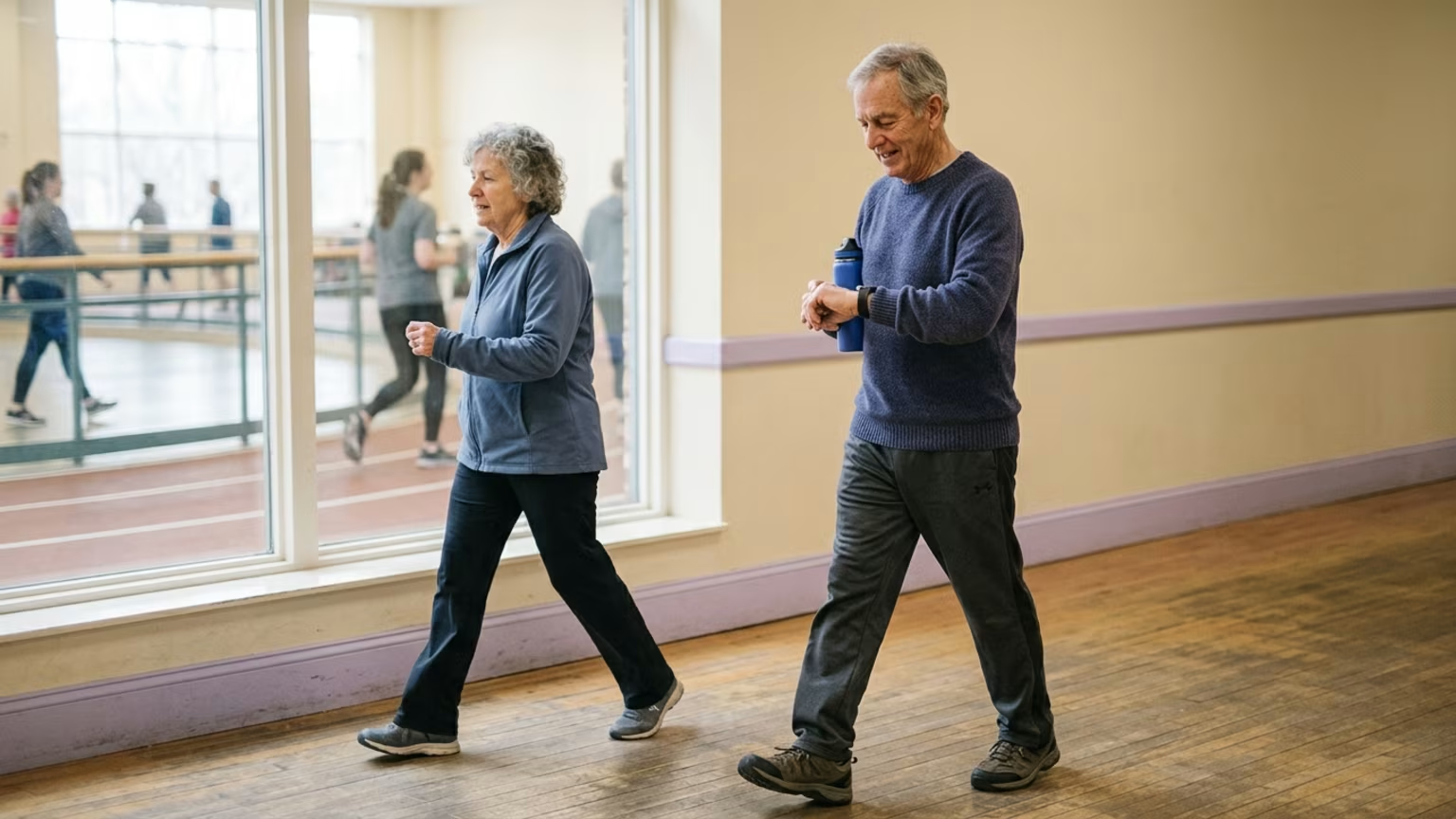

A 2026 study suggests both walking pace and step volume influence mortality risk. Learn how this flexible approach applies to active aging and physical recovery.





On September 8, 2026, the British Journal of Sports Medicine published a detailed study on walking habits. The researchers analyzed how combinations of stepping intensity and daily step counts relate to mortality. They drew their information from UK Biobank participants who wore activity trackers for seven consecutive days between 2013 and 2015. The analysis focused on finding patterns between daily movement habits and long-term health outcomes. The findings showed that both higher daily step counts and a faster walking pace were associated with a lower risk of death.
The study’s publisher reported that faster stepping among people taking fewer than 5,000 daily steps was associated with a substantially lower risk of death. The researchers described this mortality-risk reduction as comparable to the risk reduction seen in people taking 5,000 to 7,500 steps at a slower pace. The researchers stated that higher intensity at a lower volume might provide health benefits similar to lower intensity at a higher volume. The researchers said the findings may inform step-based approaches for middle-aged and older adults who face barriers to increasing daily steps or pace. This gives a new perspective to active adults looking to build a sustainable physical routine.
People often hear that they must walk a certain number of steps every day to stay healthy. A high daily step goal can seem like a mandatory threshold for anyone wanting to maintain their physical function. For active adults recovering from an orthopedic issue, reaching high step counts is often impossible during the early stages of rehabilitation. Pain, limited mobility, and medical restrictions frequently keep daily steps quite low. This rigid focus on volume can make the recovery process feel overwhelming and discouraging.
When volume is the only metric of success, people facing physical limits might wonder if shorter walks are even worthwhile. A person restricted to brief periods of movement might feel they are falling behind a standard fitness goal. This single number does not account for the natural phases of tissue repair or the need for a gradual return to activity. It ignores the reality that recovery involves small, incremental improvements over time.
Many fitness programs operate on the assumption that more volume is always better. This perspective ignores the physical toll that excessive walking can place on healing joints and muscles. When a person is actively engaged in physical therapy, their energy is already being directed toward targeted exercises. Adding a massive daily walking requirement on top of that clinical work can easily lead to overtraining. A smarter approach recognizes that everyday activity must scale to match the body's current capacity for recovery.
A recovering patient needs a framework that values small efforts rather than expecting a sudden jump to long distances. Setting a smaller, achievable target often builds more confidence than failing to meet an arbitrary high number. It is helpful to understand how to build a walking routine safely to support these early efforts, but the actual volume of walking must remain manageable. Recognizing that small amounts of movement have value can help reduce the anxiety associated with physical rehabilitation.
The new study compared several daily step-count groups to understand the relationship between walking habits and longevity. The researchers separated participants into groups taking under 5,000 steps, 5,000 to 7,500 steps, 7,500 to 10,000 steps, and over 10,000 steps a day. They then compared these groups with the stepping pace recorded during the most active half-hour of the participants' days. The researchers found that the 7,500 to 10,000 daily step group had the lowest reported mortality risk among the step-count groups. This was true irrespective of their walking pace.
The study publisher highlighted a specific detail regarding pace for those with lower step counts. A pace of at least 80 steps per minute among people taking fewer than 5,000 daily steps was associated with a substantially lower risk of death. Furthermore, maintaining a higher pace for at least 30 minutes per day was associated with progressively lower all-cause mortality among those taking fewer than 7,500 steps. These findings suggest that walking intensity might offer a different path to health benefits when high volume is not possible.
The study’s publisher indicated that this association offers a potential alternative for those who cannot tolerate high step volumes. This is particularly relevant for individuals managing joint pain or recovering from a recent surgery. A brief period of brisker walking might be easier to manage than an hour of continuous slow pacing. The data supports the idea that the body benefits from varied forms of movement intensity. This concept challenges the older idea that only long bouts of exercise provide significant health improvements.
A Harvard Health article summarizing the findings suggests 90 to 100 steps per minute for 30 minutes a day as a promising general target. That same article notes that people facing limits in time or physical ability may benefit from flexible combinations of steps and pace. This flexibility allows individuals to adjust their movement based on what their bodies can tolerate on any given day. Instead of forcing a high step count, a person might focus on a shorter, slightly brisker walk when appropriate.
It is important to understand exactly who was included in this observational research. The analysis of deaths from any cause included 64,743 people with an average age of 61. The separate cardiovascular-death analysis included 70,075 people with an average age of 62. These participants were part of the UK Biobank, a large-scale biomedical database used for health research. Over an average follow-up period of about eight years, 1,697 participants died from any cause. This total included 502 deaths from cardiovascular disease.
The study focuses entirely on middle-aged and older adults in a general population setting. It describes associations between measured walking patterns and later outcomes for this specific group. These results do not represent a tested recovery plan for people after surgery or injury. The data simply shows a link between certain habits and health outcomes in a broad group of people.
The findings should not be presented as a personalized recommendation for a recovering adult. A person dealing with a joint replacement or a muscle tear has very different physical needs than a typical study participant. Their joints and tissues require a carefully managed timeline for adding stress and load. A general population study provides helpful context, but it does not replace a supervised rehabilitation program.
Anyone managing an injury should always prioritize the clinical guidance provided by their healthcare team. Applying broad research findings to a specific clinical situation requires professional judgment and a clear understanding of the patient's medical history.
For someone rebuilding their physical capacity, the most defensible takeaway from this research is flexibility. The study supports discussing both walking volume and walking pace with a clinician. It suggests that a single step-count target is not the only meaningful option for staying active. A person who cannot comfortably add much distance might ask their rehabilitation professional whether brief, controlled increases in pace are appropriate. This is a cautious application of the findings rather than a strict protocol.
Experts view this flexibility as a positive shift for active aging and movement routines. Sports-medicine physician Denice Ichinoe told National Geographic that the findings move away from a single target number of steps. She noted that both walking volume and briskness may matter for long-term health. Cardiologist Rosy Thachil also told National Geographic that people who cannot reach a high step count may still benefit. Thachil suggested that making some walking more purposeful and intense could be helpful for those individuals.
Ichinoe advised focusing on a realistic way to move consistently. This might involve gradually adding walking through the day or including brisk intervals. She also cautioned against feeling compelled to chase a particular number on a watch. National Geographic reports that pace and step targets should be considered in light of a person’s age, fitness, mobility, and enjoyment. Progress must always be framed around an individual's current ability and their specific recovery plan.
This flexibility removes the pressure to perform at a specific level every single day. Some days might allow for a longer, slower walk around the neighborhood. Other days might only permit a short walk to the store, but at a slightly faster pace. Both variations offer value and contribute to the overall goal of maintaining physical function. Anyone figuring out how to return to exercise after a break can use this flexible mindset to build a sustainable routine.
While the data offers a helpful perspective, the research was observational. This means the study cannot establish that taking more steps or walking faster actually caused the lower mortality risk. The activity trackers only captured movement during one seven-day period. The researchers then followed the participants' outcomes over about eight years. The study describes associations between those measured walking patterns and later outcomes, rather than the effect of a prescribed walking intervention.
The study also spanned several years, meaning that participants' health statuses likely fluctuated during the follow-up period. This natural variation in human health makes it difficult to draw rigid conclusions from a single dataset. The research provides a snapshot of habits rather than a controlled experiment with isolated variables.
There are also limits to how specifically these findings can be applied to risk reduction. The Harvard Health article discussing the study does not supply exact percentage reductions or hazard ratios. The publisher’s summary likewise does not provide numerical effect sizes. The step-count band associated with the lowest mortality risk was 7,500 to 10,000 per day. Because of this, the findings do not show that a faster pace fully replaces the benefits of a higher step volume.
The sources do not establish a specific safe pace or progression schedule for post-injury recovery. The findings do not justify advising every recovering reader to aim for 80, 90, or 100 steps per minute. Physical-therapy professor Matthew Bowman recommended checking with a doctor before increasing walking intensity. He emphasized this caution particularly for someone with a health condition. Understanding how age, health, and activity interact requires a tailored approach rather than broad population guidelines.
We started by looking at the September 8 study as a new way to measure daily movement. The findings remind us that strict step counts are not the only valid measure of physical progress. A healthy walking routine does not depend on a rigid number on a screen. By understanding that both pace and volume play a role, recovering adults can focus on realistic ways to challenge themselves. Flexibility in how we move often leads to a more consistent and sustainable return to activity.
Adapting broad population fitness targets to a restricted rehabilitation timeline requires careful judgment, and ReboundBody provides the editorial context needed to navigate those limits safely. By removing the difficulty understanding clinical terminology and research findings, we help active adults build realistic expectations for their return to everyday movement.

Follow ReboundBody for practical articles on injury recovery, rehabilitation, mobility and rebuilding strength. New posts turn research into clear ideas for the road back to activity after injury or surgery.



Read practical guidance on injury recovery, rehabilitation, mobility and rebuilding strength as you work your way back to activity.
Explore Resources