

Cleveland Clinic describes how wearables track walking and joint motion in orthopedic rehab, and where those readings fit in recovery decisions.





On November 23, 2026, Cleveland Clinic’s Consult QD described how wearable sensors add numbers to something physical therapists already watch closely: how people move after an injury or surgery. Depending on the device and the stage of recovery, a therapist might track how fast someone walks, how far a joint moves or how the foot meets the ground.
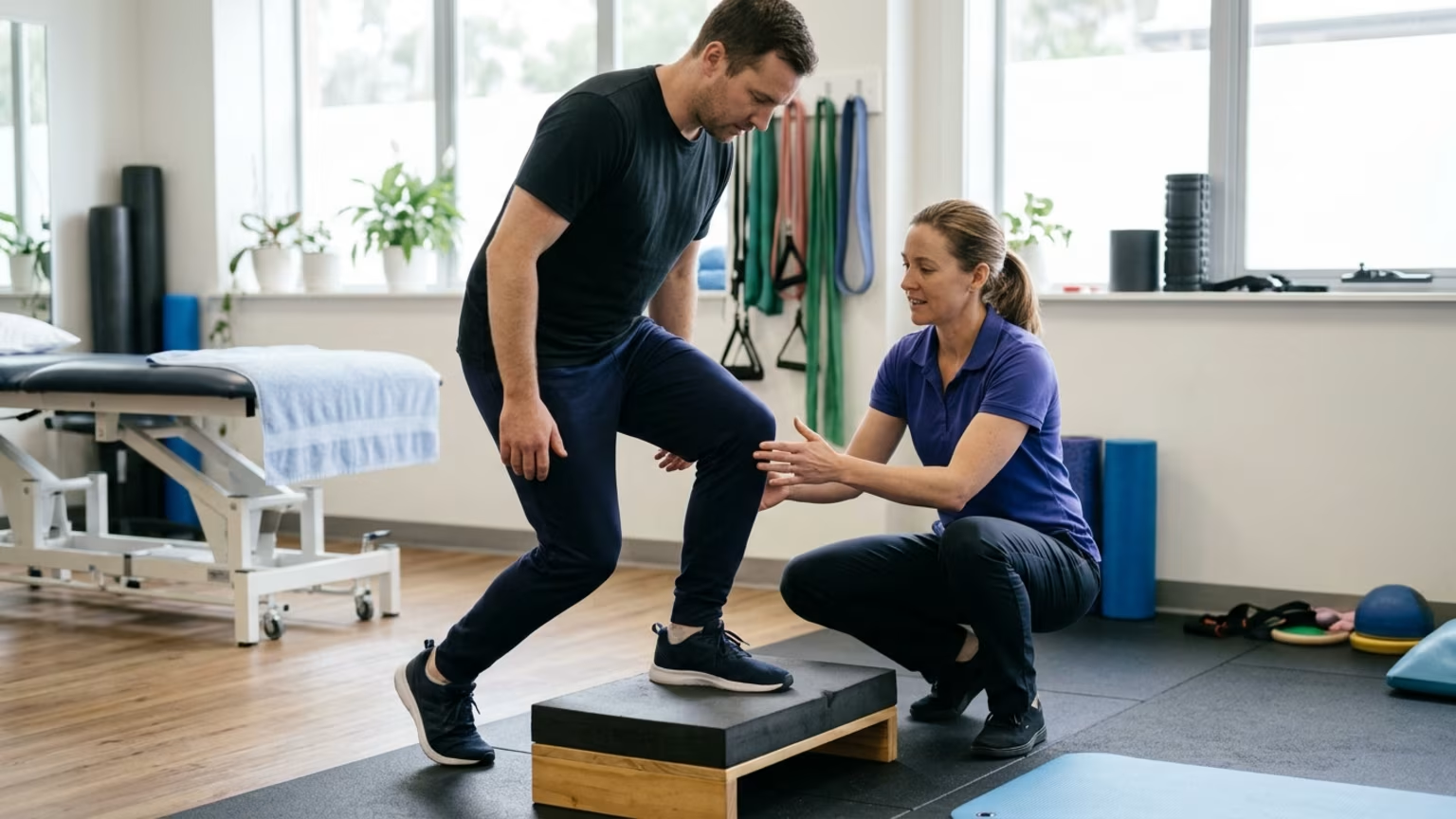
Gary Calabrese, DPT, Cleveland Clinic’s Senior Director of Rehabilitation and Sports Therapy, says those readings can help clinicians assess movement more objectively and tailor care. His example after knee surgery is straightforward. Rather than relying on sight alone to judge whether the knee straightens during a step, a therapist can check the recorded angle and consider whether the result warrants a change in treatment.
Calabrese describes visual observation as a starting point that sensor data can supplement. A therapist still has to decide which movement is worth tracking and how the reading fits with the rest of the visit. That distinction matters in any assessment of how you move: recording a movement and interpreting it are different tasks.
The Consult QD report is new, but the clinic’s use of the technology is not. Calabrese says Cleveland Clinic began bringing sensors into physical therapy roughly a decade before the report. The clinic evaluated approximately five to seven systems and now routinely uses two or three, mostly for rehabilitation involving the legs.
Calabrese also describes a shift in how often some patients attend therapy. He says rehabilitation after anterior cruciate ligament (ACL) reconstruction that once included 30 or more visits may now average 10 to 12. That is his account of practice patterns, not a national benchmark or evidence that wearables caused the change.
Cleveland Clinic describes tools that include accelerometers, gyroscopes and clothing that tracks motion. What a clinician records depends on the job the device has been chosen to do. An in-shoe sensor can track walking patterns after an Achilles tendon repair. In knee rehabilitation, the report describes measuring joint motion and walking before turning to later tasks such as speeding up, slowing down or changing direction.
After ACL reconstruction, Calabrese gives the example of measuring the knee angle during walking. The question is whether the knee reaches full extension, meaning it straightens all the way during that movement. The reading gives the therapist a specific detail to consider when deciding whether to adjust care.
That focus matters when someone hears that a device is tracking range of motion during rehabilitation. Knowing the device is recording a knee angle is only part of the explanation. Knowing that the therapist is looking at how the knee straightens during a step makes the purpose clearer.
In a 2026 study published in the Journal of NeuroEngineering and Rehabilitation, researchers used wearable movement sensors and a personalized model to estimate hip joint moments during walking. A joint moment describes a turning effect at the joint. The researchers looked at how those estimates changed through the walking movement rather than treating joint loading as a single score.
In a separate evaluation of walking over the ground, the model reported waveform correlations of 0.91 for hip adduction moment and 0.93 for hip flexion moment. In plain terms, the estimated patterns closely followed the reference patterns for those two measures in the test. These are correlations, not percentages of accuracy.
The hip study included 84 participants: 34 people with hip osteoarthritis, 19 healthy older adults and 31 healthy young adults. The inclusion of people with hip osteoarthritis and healthy older adults makes the study relevant to walking and mobility research beyond competitive sport. Its findings apply to the walking tasks tested, which included normal and modified gait.
The Cleveland Clinic report describes separate uses for people recovering from other conditions. After shoulder surgery, a therapist might track shoulder motion. For overhead athletes returning after an injury to or reconstruction of the ulnar collateral ligament in the elbow, the report describes estimating elbow torque and tracking workload. Those examples illustrate how the choice of measure changes with the activity and the recovery goal. They were not part of the hip study.
Calabrese recommends choosing sensors that fit the people being treated and the question the clinician wants to answer. He also favors a small number of useful measures over a long list of readings. For someone in rehab, the clearest explanation may be as simple as naming the movement being tracked and saying why it matters at this stage.
If a therapist suggests using a wearable, these questions can help make sense of the reading:
It helps to keep the measured task and the personal goal in view. A reading from a walk in therapy may answer a narrow question about that walk. A conversation about getting back to a regular activity can put that finding in the context of other milestones during recovery.
The Cleveland Clinic report describes how clinicians use wearables, but it does not establish that patients recover faster or have fewer repeat injuries because of them. The hip study tested how well the model estimated movement-related loading during walking. Neither establishes wearable readings as a standalone test for deciding when someone is ready to return to exercise or sport.
Remote monitoring raises a separate question about when an in-person visit is needed. Cleveland Clinic reports that remote monitoring has reduced clinic visits for some people recovering from rotator cuff repair. Calabrese says the clinic has not seen the same reduction in other areas of rehabilitation. That experience does not show that home monitoring can replace in-person assessment across orthopedic conditions.
There is still value in seeing one part of a familiar movement more clearly. Sometimes the most useful thing a sensor offers is a closer look at a single step.
A change measured during therapy can mark progress without capturing the full work of getting back to everyday activity. Through independent coverage of movement and recovery, ReboundBody helps active adults in midlife and later life put rehabilitation milestones in context as they consider returning to the activities that matter to them.

Follow ReboundBody for practical articles on injury recovery, rehabilitation, mobility and rebuilding strength. New posts turn research into clear ideas for the road back to activity after injury or surgery.




Read practical guidance on injury recovery, rehabilitation, mobility and rebuilding strength as you work your way back to activity.
Explore Resources